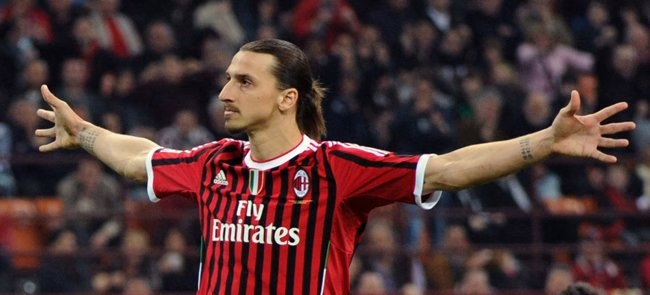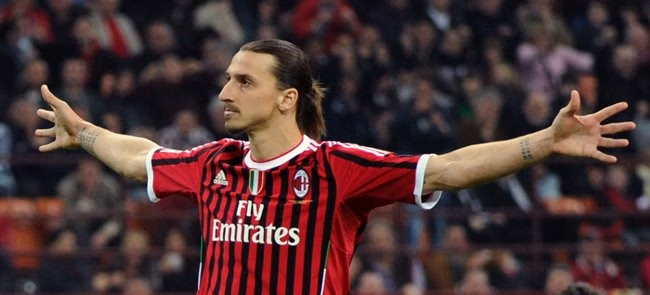


Zlatan Ibrahimovic is currently one of the best attacking football players in the world. He is certainly not the best, as ecstatic Swedish football fans sometimes preach. But he certainly qualifies amongst the thirty major artists in all the world’s arenas where the ’green field’s chess’ is played – and that is ‘big’, as Zlatan himself would say. Football is, after all, a gigantic sport, the best known across the world.
What Zlatan Ibrahimovic has done with his life is certainly an achievement! If we did not already know that, we were told so in David Lagercrantz’s book I Am ZlatanIbrahimovic: the international star had a career against all the odds. A socially stigmatised second-generation immigrant kid from Rosengard; the son of divorced, poorly integrated, poor parents from the disintegrating former Yugoslavia, who forced his way into the elite of a mentally and physically demanding sport – who is also Sweden’s most cherished. He made his way on pure talent and a desire for revenge – as so many other resources were not available to him.
“You can take a guy from Rosengard but you can never take Rosengard from a guy”, said Zlatan Ibrahimovic, in one of the few examples of self-discovery in the above-mentioned book. Perhaps he is even aware of the shadow this very fact throws over his success story as a prominent figure in Swedish football (currently the only undisputed superstar). For Zlatan Ibrahimovic is not just divine ball skill, or an intelligent player who, for his physical constitution, is amazingly fast on the pitch. He is also a troublemaker with an ungovernable temper, poor impulse control and much arbitrary in his social attitudes.
As a boy in Rosengard, Zlatan Ibrahimovic was a wild adult, and before that a truanting scoundrel, a bicycle thief doubtless with more serious crime waiting around the corner – if it had not been for football, which took care of his burning thirst for ”respect”. He was also raised in an environment where words such as forgive and compromise did not exist, where attack was the best defence, and where unreason was synonymous with strength. In any case, this is what he said to his biographer.
Zlatan Ibrahimovic has taken all these attitudes with him into his international career. The success and worldliness may have dampened his intransigence a little, but if you pay attention to what Ibrahimovic says in David Lagercrantz’s book, one finds that he still is a man who celebrates the absolute and authoritarian approach, who despises weakness and defines his key word respect in the manner characteristic of gangsters:
“Respect is not something you get”, says Zlatan Ibrahimovic and quoting the stern football coach, Fabio Capello, who recently resigned from his post as coach of the England football team, incapable of compromise with his employers in a delicate personal matter. ”Respect is something you take,” he adds. Implicitly: respect is something that threatens or forces through superiority and inferiority. I do not think there are so many democratically minded people who would subscribe to that definition of respect. In democratic reference systems, respect is the same as the esteem one can feel for someone whose charisma and / or performance makes an unusually creditable impression on one. Or respect is also a general attitude of man – an authentic spirit of his integrity.
In an article in Göteborgs-Posten in February this year, I drew attention to Zlatan Ibrahimovic’s domineering manners, and asked if he was indeed an appropriate choice to be the captain of the Swedish football team. Of course Zlatan is an asset for the Swedish national football team but, by elevating him to the captain, it provides his despotic personality with a formal authority that it should not have. Partly because Zlatan tends to paralyse parts of the rest of the team, the ‘blue and yellow’ sometimes play better without than with Zlatan. Partly because Zlatan’s social attitudes seriously contradict the expectations placed upon a person who has the honour of leading the national team in Sweden’s most popular sport.
In the article, I pointed out that the book about Zlatan Ibrahimovic not only sold copiously, but also had become something of a textbook for the winning spirit in youth sport organisations. Zlatan was set up in the media as a role model for all young people who wanted to fight their way in life.
I was a little concerned that so few influential opinion makers had drawn attention to the deeply problematic elements of Zlatan Ibrahimovic’s values ??and attitudes – not exemplary for young people that ought to be socialised into communities with other notions of respect and of human community than the one to which Ibrahimovic subscribes.
But what is a role model? asked many who, after my article, continued the discussion on the phenomenon of Zlatan Ibrahimovic. Who creates role models? Zlatan has not asked to be a role model! So went the debate on the fascinating, but also a little repulsive, book I Am ZlatanIbrahimovic, which took place at the National Press Club in Gothenburg some time ago.
Role models exist at various levels of our social orientation system.
To begin with, we have personal role models, who tend to be of our childhood and youth, and who are a kind of guide through adolescence. They are figures that give body and soul to our often unspecified personal desires, inclinations, dreams and aspirations, but also to the outside world’s expectations of us. These figures also help to shape our new ambitions, in an interplay between projection and inspiration.
When we are small, we pick up the role models from the world directly around us: parents, older siblings, other adults, as well as older and precocious comrades from our everyday inner circle. Eventually, as childhood finishes, these figures are supplemented or replaced by others who populate the more distant horizons of our growing experience and who transform into human representations of something desirable. They come to us throughout our network. They are fictional or real existing ‘idols’ that perform many functions in the shaping of our personalities – what we call our identity. They may have achieved what we want to achieve, they may open the door to a secret wish that we did not even know we had. They may give us purpose and meaning in our journey by playing a social role we are keen to take on. Perhaps we identify with them so strongly that they become so-called reflections of ourselves, figures we constantly fantasise about as companions in our lives as a kind of double exposure of ourselves.
When we grow up, and hopefully settle into a life that satisfies us, these role models fade away after they have helped in our development. Later in life, role models at the most give us inspiration, as those who have gone before us on the path of life we ??finally selected, which encourages us to go on.
All those who have named Zlatan Ibrahimovic as a role model for young athletes in general, and particularly for boys and girls at the margins of society, are of course justified in their claim, like it or not. If you succeed in turning your life around 180 degrees away from what looked to be a terrible predetermined fate, and you do it with talent and tenacity, it is clear that you become a role model and a human incarnation of the world’s dreams for thousands with an origin similar to your own. One should perhaps recall that Zlatan Ibrahimovic’s success story is not just about an unusual ball talent and about the luck of being discovered. It is mostly about training so persistently that it bordered on obsession.
So far, the example of Zlatan is a fairly simple story. A more intricate question on the subject can be asked: is there something about Zlatan that is not about the football genius and success, which makes many place him on a pedestal? Is there anything beyond the football star’s performance that means that, when the national team trains with him on the field, thousands of spectators come to the grandstands, when normally only a hundred would come?
One of the reasons that there was considerable outrage, especially online, amongst Zlatan’s fans when I claimed that Zlatan is not a good role model for today’s youth, despite his career, was probably due to the fact that many young people look up to Zlatan as a person. The most vocal of his admirers were not even always interested in football.
Zlatan Ibrahimovic is a charismatic man, which explains some of the devotion he induces even if his charisma is not easy to explain. But I think Zlatan arouses unusually strong enthusiasm because he appeals to the rebellious, misguided young people who identify with his grandiose unruliness. The laws that apply to others do not apply to Ibrahimovic. He is a big, strong outlaw – a yellow-eyed eagle soaring and doing what he wants, cheering many small rebels from towns all over the world, where people are restrained by all manner of coercion and miserable conditions.
In other words: precisely those characteristics that I considered to be Ibrahimovic’s handicap, which made him a role model for young people and the captain of the national football team, are the characteristics of the star which, for his fans, ignite their unspecified personal and collective aspirations.
Perhaps the view I expressed in my article revealed more about myself, my age, my ethnicity and my privileged social status than about Zlatan’s qualifications as an role model for those who may be most in need of role models to not be discouraged by the hopeless life that appears to be in store for them?
Nevertheless, role models in our society are not only personal objects of identification for people and groups in search of a life. Role models also have a public function in the sense of being ‘pioneers by example’, in relation to society’s generally accepted values. More concretely, in this respect: people who, for various reasons, are publicly celebrated are expected to be, if not entirely virtuous, then at least without transgression in relation to the codes and standards that constitute our society’s binding element.
I have often found it difficult to discuss the role models put forward in the mass media, often in connection with an attack on a famous person, who is considered to have breached their duty to act as a role model to the public.
Leading politicians are not elected to their positions as role models in any moral sense. They are elected for their political programme – even though they, of course, in general, behave so as not to forfeit the confidence of voters. The same thing, I think, applies to other people in the public arena that have risen by virtue of their efforts or accomplishments. Role models need not be beyond reproach, but they have to weigh their conduct in relation to the degree of personal credibility they need in their duties. A minister cannot afford as much as an artist.
To my mind, the media is obviously hypocritical when it excuses the violation of any celebrity’s privacy on the grounds that their celebrity makes the person a role model whose private life has to be scrutinised.
With prominent sports stars, the situation is slightly more ambiguous. They have reached their fame through their performance, and it would be presumptuous to claim that, because of their success, there has to be a pattern for individuals in relation to all other aspects.
However, we know that athletes tend to simultaneously be role models both on the personal, projective level and the general exemplary level.
Therefore, a top athlete’s personal appearance and general behaviour has a significant impact on the attitudes of those who admire them. Of course, top athletes do not exist in a social vacuum – their attitudes and actions are naturally affected by what is generally acceptable within the community that has nurtured them.
It’s no coincidence that it was an American (John McEnroe) who first broke the taboo against uncontrolled behaviour on the tennis court. In the US, self-centred wilfulness is more viable than in Europe’s often reserved and etiquette-conscious cultures. However, McEnroe also proved to be the harbinger of the dissolution of the disciplined ideals of tennis as a sport – and God knows, not just there.
Goal-scorers continue to find new militant, or sexually potent, victory gestures, which reflect the spiritual atmosphere of the twenty-first century world in which power, body and sex are hard currency. But football players’ sometimes obscene language of symbols, which FIFA by all means tries to keep in check, charges the explosive atmosphere amongst the football audience around the world even further; the process is mutually reinforcing.
Precisely because athletes appear before a mass audience with a desire for identification and imitation means that the question of what kind of role model they are is not unimportant.
In this respect, Zlatan Ibrahimovic embodies a cultural split, an almost ideological contradiction. If someone, like Ibrahimovic, is given the duty to lead the Swedish national football team, it can be reasonably expected that he will act as a representative of Sweden, and of its social and political culture in the broadest sense. While it seems that what actually lifts Zlatan in the eyes of young people and makes him an idol that can lay claim to the captaincy, are the properties (other than his football abilities) about him that run contrary to Swedish tradition, namely the challenging approaches I mentioned in beginning of this article.
Perhaps it is as simple as to say that people like me, with deep roots in Nordic democracy, are concerned that Zlatan Ibrahimovic represents the new values ??of a globalised world: the individual has only himself to rely on in the battle for a ‘place in the sun’. Aggressive strength, determination and a degree of ruthlessness are, in this context, not to be despised. The cosseted enthusiasts of democracy need not apply.

Redan prenumerant?
Logga inUpptäck Axess Digital i 3 månader utan kostnad
Allt innehåll. Alltid nära till hands.
- Full tillgång till allt innehåll på axess.se.
- Tillgång till vårt magasinarkiv
- Nyhetsbrev direkt till din inbox