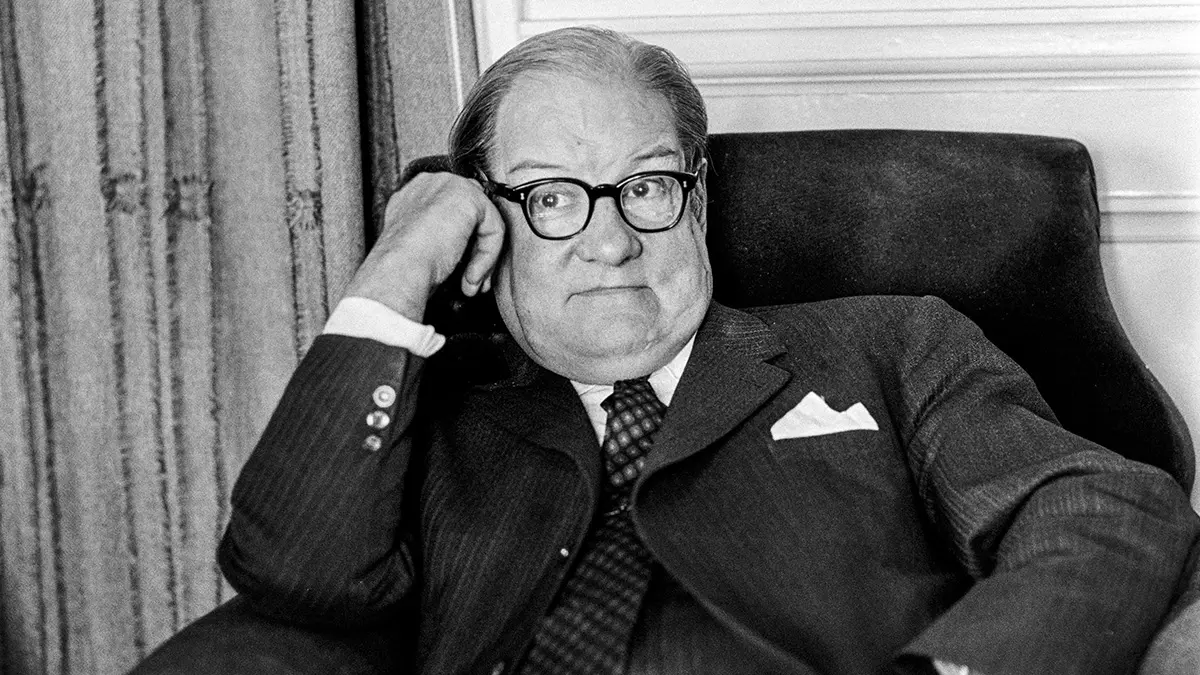
In 1959, the American sociologist C. Wright Mills published a book titled The Sociological Imagination. In it, he argued that US citizens needed a new ”quality of mind”, an awareness that allowed them to connect their personal lives with the great social changes taking place in post-war American society. In Mills’ eyes, it was the job of sociologists to expand people’s perspectives, to get them to see what was really happening in what seemed to be happening. At the same time, Mills argued that established sociology was a failure. It was trapped in conventional wisdom, which could imagine nothing other than the society that existed and which ruled out the notion that the dramatic upheavals of times past could not be repeated.
Similarly, in my view, the same holds true of today’s official Swedish – and, as I understand it, European – approach to security. There is almost a complete lack of what one might call ”historical imagination”: an awareness that the peace and security established in Europe after the fall of communism were not the result of the triumph of common sense and justice, but were instead simply based on the then military, industrial and political superiority of the West; an understanding that international politics is essentially a power struggle aimed at dominance, either through peaceful or violent means; a realization that it was not just what the sword produced that was fragile and transitory, but also that what peace and democracy had achieved was uncertain and impermanent. In short, a geopolitical struggle for existence could very well be waiting around the corner for people in Europe today, just as it did in its time for the peace-loving generations of the interwar period.
This lack of imagination is actually astounding, given the unforeseen and dramatic upheavals that have taken place since 1989. What security analyst predicted that the Wall would fall and the Soviet Union would break up? Who foresaw that Germany would be reunified? And who foretold that Europe would experience a nationalist-religious war and ethnic cleansing in the 1990s? The fact is that everyone was caught unawares by the upheavals of 1989.
In light of these failures, one might have expected the security establishment to realize how short historical memory is and broaden its perspective, that it would recognize how uncertain and unpredictable the international order is. Not true. The tendency has been the exact opposite. After the successful enlargement in the 1990s of both the EU and NATO, there was almost unanimous agreement among experts at security institutes, military staffs and foreign ministries which assured citizens that Europeans had achieved what Immanuel Kant called ”perpetual peace”. War between nation-states, it was argued, belongs to times past. Mutual economic dependence between the countries of the world had made war far too expensive. The era of conscript armies was at an end, it was said. Instead, the future belonged to small, network-based task forces. Today, new institutional security arrangements and partnerships guarantee peace and stability in Europe. As a result, the EU countries, with Sweden being the most extreme example, have cut defence spending, apparently unaware that all the big countries in the world are increasing theirs.
Typically enough, it is an American historian and security realist – Robert Kagan – who has deflated this wishful thinking. In two essay-like books – Paradise and Power. America and Europe in the New World Order (2003) and The Return of History and the End of Dreams (2008), Kagan has developed a detailed and decisive critique of the liberal-idealist outlook that characterizes the European approach to security. Kagan was born in 1958, the son of a Yale classics professor. After completing his PhD, he was hired by the Reagan administration and joined the staff of Secretary of State George P Shultz. After this, he became affiliated with the Carnegie Endowment for International Peace as a researcher and established himself as a writer on security policy for a number of leading newspapers and magazines in the US. Today he is one of John McCain’s foreign policy advisers.
The main thesis of Paradise and Power is that the US and Europe have drifted apart on security matters since the end of the Cold War and have developed two completely different ”strategic cultures”. Whereas the US has essentially maintained the position it adopted during the Cold War and is always prepared to use military force if there is a perceived threat to the nation’s interests, the Europeans – in Kagan’s view – have adopted a new stance. The EU emphasizes above all the importance of diplomacy, negotiations and mutual understanding. They reject the use of military force except as an absolutely final recourse and claim that the exercise of force must be in conformity with international law and sanctioned by the UN Security Council. Since 1989, Kagan argues, the Europeans have essentially repudiated the notion that international relations concern realpolitik, spheres of influence and balance of power. They instead project the EU’s successful concept of the international order and maintain that – like with the EU itself – it must be based on established principles of law and human rights. The implicit idea of course is that, if the nations of Europe have been able to transcend war and geopolitical struggles for power, then every nation can. Nor is there any doubt that the peaceful dissolution of the Soviet empire in the 1990s was thought to confirm the liberal idealist notion that the international community was irrevocably on the path toward more permanent peace and cooperation founded on international law and collective security arrangements. This view was reinforced by an enlargement of the EU and NATO to include Eastern and Central Europe that was free of conflict. A broad array of politicians and experts in Europe came to see the EU’s soft diplomacy and law-governed cooperation as a model for the new world order.
A central thesis in Kagan’s new book, The Return of History, is that the years of peace between 1991 and 2003 were not the start of a new, enduring era, but simply a break in the geopolitical competition between the great powers. What took place in the 1990s was a drastic shift in the global balance of powers; the bipolar order of the Cold War had been replaced, as a result of the collapse of the Soviet Union, by unipolar American hegemony. Protected by this hegemony, the EU and NATO could incorporate the former Soviet satellites without a fight with Russia. What happened after 2003, Kagan writes, is that Russia shifted toward an increasingly authoritarian and nationalist course, not a liberal, democratic one as many had hoped in the 1990s. Kagan argues very convincingly that the world is now back to a classic rivalry between the great powers (”the return of history”), where the crucial dividing line is between authoritarian-run states and liberal democracies. The fight today is not about ideological influence, as it was during the Cold War, but rather about geostrategic positions of power, about control of resources, about trade routes by sea and land and about food and energy supplies, and last but not least about making both enemies and friends respect them. In other words, the world today looks just like the world before 1914 and the hundred years before that.
Kagan’s analysis is pithy and pertinent. It provides a historical frame for understanding the power struggle between the Western democracies and the authoritarian and highly frustrated Russian state. The war with Georgia that took place just a few months after Kagan published his book confirms the essential points of his analysis. Above all, the war shows that Russia wants to revise the security order established by the Western powers after the breakdown of the Soviet empire. However, no one believes that the Russians currently have plans for territorial conquests – that they want to incorporate one or several of the former Soviet republics in the classic way into a new Russian empire. The goal instead is to gain critical influence over the policies of the neighbouring republics, especially over their relations with the Western world and their energy policy. With its move against Georgia, Moscow has demonstrated several important things to the countries in Central Asia and the Caucasus in particular and to the Europeans and Americans in general.
First, the Russians showed that they do not hesitate to use military force to uphold their interests in neighbouring countries. Second, the war showed that international law and international agreements do not provide protection for the countries in Russia’s proximity. The third and perhaps most important lesson was that the West – the EU and the US – was neither capable nor willing to provide Georgia with military aid when the country’s survival as a sovereign state was under threat. Fourth, Russia succeeded in breaking Georgia apart territorially without it leading to anything other than diplomatic responses from the rest of the world. Finally, Moscow took the opportunity in the midst of the crisis to revise its dealings with Georgia into a new security policy doctrine, a doctrine that received only scant attention in the West. During the last weekend in August, Medvedev, the new president, gave an interview on Russian television in which he stipulated the following five points:
– Moscow recognizes international law as a fundamental principle of relations between countries.
– Moscow rejects the idea of a unipolar world and American hegemony.
– Moscow does not want confrontation with any state in its proximity.
– Russia has an unquestionable duty to protect the lives and dignity of Russians living in non-Russian nations. The same duty also applies to Russian business interests abroad.
– Russia has a ”privileged interest” in areas where Moscow has a special historical relation.
In actuality, the Kremlin laid down the equivalent of America’s Monroe Doctrine from 1823. Just as Washington does not accept non-American powers interfering with affairs in the American hemisphere, Moscow maintains that Russia has a right of precedence in the affairs of its neighbours. The fact is that this doctrine kicks the legs out from under the security order established in Europe after the fall of the Soviet Union. It considers the expansion of NATO, especially the plans to make Ukraine and Georgia new members, direct interference in Russia’s sphere of interest. The doctrine also emphasizes that the invasion of Georgia was not the consequence of an isolated conflict with historical roots, but rather the result of a new attitude in Moscow to Western actions in countries neighbouring Russia.
For the West, however, it is not a question of its ”actions”. Instead, Brussels and Washington both maintain that Georgia and Ukraine are fully entitled as free and sovereign states to determine what foreign policy they wanted to pursue and what organizations they wanted to join. The European nations continually emphasize that they do not want a ”power struggle” with Russia: on the other hand, they do want to extend the model for peace, prosperity and stability that they think – quite rightly – the EU and, for that matter, the ”new” NATO represent. Seen from the perspective of the ruling Russian elite, however, Western behaviour looks completely different. There is no doubt that enlarging NATO to include the whole of what was once Moscow-dominated Eastern Europe has weakened Russia’s geostrategic position. The recently signed missile agreement between Poland and the US, which includes the stationing of American air force troops on Polish territory, forcefully underscores this weakening. Should Ukraine and Georgia likewise be incorporated into NATO, then Russia is in reality surrounded by the Western military alliance.
The Russian invasion of Georgia should be seen in light of this. From a geopolitical perspective, it is a question of a rational and logical move against what Moscow perceives to be a growing threat from the West. In other words, Georgia was no local conflict that got out of hand, but rather the first step of a carefully prepared Russian policy to drive NATO and the EU from the vicinity of Russia and in the long run reclaim Moscow’s dominant influence over what has historically been a Russian sphere of influence. It is clear that this new Russian strategy has taken both the European countries and the US by surprise. The EU countries had certainly not expected that, as a result of those countries giving their support to an expansion of the European model for peace and democracy, they would be thrown back into a traditional geopolitical power struggle with Russia. Nor could they scarcely have imagined that the European security structure of agreements and institutions established after the Wall fell would be demolished in a single blow. Yet that is exactly what happened. In a publication of the highest international quality from the Swedish Defence Research Agency (FOI), Det kaukasiska lackmustestet: konsekvenser och lärdomar av det rysk-georgiska kriget i augusti 2008 [The Caucasus Litmus Test: Consequences and Lessons from the Russian-Georgian War of August 2008], the authors write that:
”Europe’s security structure [after the Cold War] has been based to a large degree on a number of agreements and weapons inspection regimes. These are now disintegrating faster than expected because of the war and its aftermath. As a result, Europe can no longer rely on these agreements as solid cornerstones of its security policy.”
Seen from this perspective, Russia’s actions in Georgia present the EU countries and the US with an extremely difficult dilemma. Should they confront Moscow’s nationalist and geopolitical ambitions for power and carry on with their enlargement plans for NATO and the EU – and thus no doubt put Ukraine at risk, as was the case with Georgia, of breaking apart as a nation. Or should they in fact adapt to Moscow’s aims in order to avoid a new Cold War in Europe – and thus accept in reality that Russia’s neighbours, like Georgia, Ukraine and Moldova, will be incorporated into a specific Russian sphere of interest? Apart from this, the situation shares significant fundamental similarities with the predicament of the Western democracies after Hitler took power in 1933 – after Germany had repudiated the Treaty of Versailles, withdrawn from the League of Nations and marched into the Rhineland. None of the Western democracies at the time wanted or could even imagine a new power struggle, and by extension perhaps war, with Germany. In the 1930s, public opinion in the West was quite understandably infused with pacifism and antimilitarism given the horrors of the First World War. The democracies’ military weakness and political reluctance to confront a new ”bully” on the international scene thus led them from one concession to another – and in the end to an unavoidable war.
The EU countries are not there today, but they can no doubt end up there, particularly if they seek to move forward with the expansion of their model – membership in the EU and NATO – while remaining militarily incapable of protecting the new states they incorporate in the community. Should the Europeans then betray their democratic values and principles of law and passively accept that they are being oppressed by the authoritarian Putin regime, not just in Russia but also in its neighbouring countries? I certainly do not mean that, but the Europeans are playing with fire if they think they can base their own security and that of others on political-moral superiority. The myth of soft power was crushed by the Russian invasion of Georgia and can not be revived. Ultimately, it was predicated on international respect for American military resources, but it is now an open question whether this respect will endure if the financial crisis in the US grows deeper and longer. The Europeans are thus forced to find a new and better balance between their own military strength and their high political-moral ambitions. If they do not succeed in this, there is a risk that they will not only have to sacrifice Ukraine’s independence, but also endanger their own freedom.