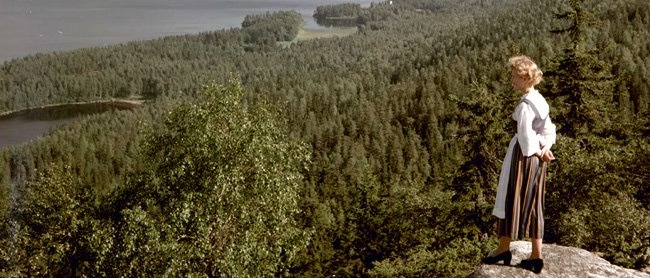
Blekinge in southern Sweden, late February. The place is called Korsanäs, ten minutes from Ronneby. For the first time in living memory, it has been a real winter here. There is a foot of snow on the ground, and a dreary darkness looms over the brick-red cottage. The cold from the sea is biting, but the cheerful crackling fire helps keep cabin fever at bay for a few days. The new shipment of books from Amazon is also good medicine. But in the end we break down. We need oxygen.
So we abandon the country and head to town, in this case Ronneby Brunn’s spa, which according to the ad gives you “Time for pleasure”. Situated in beautiful Brunnsparken, whose greenery is presently rather chilled and covered in snow, the place provides room to breathe – and an odd sense of cosmopolitan peasantness.
A quick show of hands among the guests indicates there are a lot of people who travelled here from all across Sweden, as well as a few foreigners, or what we in this province now tend to call Germans and Danes.
Some are sitting in the Jacuzzi, getting a Thai massage or eating biodynamic food. A few are celebrating their 60th birthday by taking the waters, others a weekend wedding. A visiting nurse is getting a chocolate body wrap for 750 kronor from friends for her 30th birthday. And grandpa is having a beer after going for a drive while grandma is looking in her discount book for a 100-kronor coupon for their spa visit.
There are representatives from Stockholm, but they keep a low profile. Not much conversation is needed to discern the subtext for those bloody people from central Sweden. Although pretty much in good fun.
The generally recognised name for Stockholmers, “zero-eights” on account of their area code, is so established that even Stockholmers use the expression. On the other hand, they are less likely to say “ninety-niners”, meaning people not 100 per cent normal, as people in the countryside do.
And Stockholm is called Fjollträsk [‘Gaytown’] or Tjockhult [‘Fatville’]. Irony about this centre of power thrives down here in Blekinge as well. But it is not as confrontational as in northern Sweden. There are vibrations here, a rare mix of criticism of power, regional identity and small-town indignation. It is there but hard to grasp.
What does this mean?, I wonder and observe the spa. Have these instant mashed-potato eaters conquered life in the big city? – with a classification of the entire country into upper and middle class, where we can no longer see any major differences between the seasoned urban dweller and the flat-footed country bumpkin? A democratisation project that goes by the name of the experience industry? Is Ronneby Brunn proof that the sullen yeoman and the fun-loving city gal have gotten together?
The perspective from my Blekinge cottage raises questions. This place is both “down here” and “out here” – “down” relative to ‘Fatville’ and “out here” relative to the town centre, which could be Ronneby, or Karlskrona, which is disparaged more openly by the other towns in Blekinge than Stockholm is.
These are interspersed 20 kilometres or so from one another in the province generally known as the Garden of Sweden. Karlskrona, Ronneby, Sölvesborg, Karlshamn, Olofström – connected by a badly abused road E22 and sporadic train service – have hopelessly decentralised Blekinge and deprived this part of the country of creating critical mass.
This cleverly concocted power structure – made to keep the occupied down – has today become an obstacle to development. The centre-periphery dimension can be found both from the perspective of Stockholm-Blekinge and within the province: Karlskrona against everyone else. The sense of mutual inferiority to the capital is easily transformed into the same feeling in the region, all the way down to the village level.
Blekinge is the Albania of Sweden, some cruel person noted. That is only partly true. Here and there, people have managed to balance deindustrialisation with a modern service sector. But if Blekinge is known for anything at all, it is still associated with shutdowns, military conscription in the marine town of Karlskrona, an almost indecipherable dialect around Sölvesborg, Carlshamn’s Punsch liqueur and Volvo production on the verge of ruin in Olofström.
When I ask people about Blekinge, these are a few of the associations they offer. Perhaps, above all, military conscription in Karlskrona. But, increasingly, also the person who today is the leading politician from Blekinge: Jimmie Åkesson, who heads the nationalist party Sweden Democrats and a native of the borderland between Skåne and Blekinge …
Perhaps it is a good model for understanding the concept of town and country to see how the discussion is based on three dimensions. First, there is the regional dimension.
Blekinge, a conquered, bullied territory in which massacres and forced removals were carried out by its Swedish occupiers, tells a tale across the centuries of a feeling of impotence. But now, as regions in Sweden are gradually reclaiming greater independence vis-à-vis the country’s central power, the situation is brighter. Stockholm is no longer what it once was. And some Swedes, like those in Skåne and on the west coast, have taken advantage of the situation and broken loose somewhat from the central state. Others have declared themselves to be a region of Europe, a bit like a banana republic, as Halland has done. Or contented themselves with raising their regional status a tad above the level of the local authority association, like Blekinge.
Sweden is regionalising. Central power is caving in; we are developing from a monocentric into a multicentric state. Second, we have the city-country dimension.
We are in the midst of a leap in urbanisation. The question is what will remain of the country when the city finally wins out. And whether the Swedish town can really be that amalgamation we associate with words like “city” or “metropolis”, and which we increasingly associate with “globalisation” because development is characterised primarily by growing gigantic clusters and development corridors, not by people no longer having to show their passport at borders. Instead, demands to show identification at border crossings have increased with even fingerprint and electronic body searches being introduced, in addition to the large number of routine requests for ID.
“Urbanisation” is a better word than “globalisation” for how the world is developing. Third, we have the centre-periphery dimension.
The centre stands for power and authority, for control and the setting of norms, while the periphery stands for object and subordination, for controlled and disciplined. Power relations can involve either our own subjective sense or an objective, observable relation. Some people think they are at the centre of power, like the undecided voter who watches a debate between party leaders shortly before election day, whereas we are really just electing which people will carry out the basics of politics. Or the opposite – others feel marginalised, based on the theme “politicians squabble and no one ever listens”, although they actually belong to the group of voters that can affect an election by a simple act of voting, where perhaps 100,000 votes are enough to change the bloc of parties in government.
So centre and periphery are obviously not geographic relations, but instead involve inherent social structures – rather like demons in people’s minds.
Let us begin with the third dimension. We often misconceive the spatial proximity between the centre and periphery of power. Without blinking an eye, politicians can say that power is moving closer to the people if it is being exercised, in sheer physical terms, close to the people. Accordingly, Stockholmers would feel more involved in parliamentary decisions than people in Blekinge would. Those six hundred kilometres devalue democratic legitimacy.
The absurdity of this reasoning is best seen in how the same politicians who blame Brussels for being far removed from Swedish reality can guilelessly defend decisions made in Stockholm and the Riksdag.
There is nothing to suggest that the distance in kilometres roots decisions more firmly. What is important is not the geographic distance between citizens and decision-makers. It is a long way to Brussels, but that is not the explanation for why we think it feels foreign. The key thing is our sense of being involved.
The figure of speech “us down here and them way up there” is strong. It is used by all political actors, albeit in different contexts. For that reason, members of the Left Party like Stockholm rather than Brussels as the centre of power, whereas Conservatives like Brussels but not those wielding power in Stockholm.
This figure of speech was also appropriated by the leader of the Christian Democrats, Göran Hägglund, when he introduced the expression verklighetens folk [‘reality’s people’] in the summer of 2009. He berated the bookish fantasy world of the newspapers’ cultural review sections and contrasted their black-garbed surliness with healthy thinking, hard-working “silent majority” average Swedes.
Göran Hägglund tried to take a stand for “normality” in an era where everything is disintegrating into a Gay Pride parade. The subtext was clear. In contrast to the spirit of the times, Hägglund wanted to say something nice about a normal heterosexual existence in a terraced house with a Saab or Volvo, a dog and a holiday spent skiing in the mountains. Of course, the message was targeted more at his own core voters and was aimed at mobilising the backbone of the party ahead of the election – something that Hägglund was helped out on by the clueless cultural left, which pounced on him with their snarling ways – but the episode was still interesting as an example of how the centre can try to mobilise those who feel marginalised.
And Hägglund’s talk about “reality’s people” is simply synonymous with those “average people” we often use in somewhat general terms. And indeed, we need not be friends with white plastic furniture, instant mashed potatoes and trips to Mallorca, but the eagerness of these media-obsessed people to test boundaries is not always so encouraging either.
At about the same time of Hägglund’s average people, Tomas Ledin’s song celebrating the middle class was released. Ledin irritated many with his lyrics about people who “go to work every day/carry the country on their shoulders”, who seldom arrive late, who love their children and drive their car “on the way to an eternal sunrise”. And the refrain thundered on about how these were the “uncrowned kings of the middle class/ Hats off, flowers in the air for the uncrowned kings of the middle class”.
Ledin sang how the middle class “are forgotten heroes who live among us/without a bonus package and have no convertible [securities], as far as I know/ they live in a totally different reality/represent long-term thinking and stability”. It raised a commotion. Some reviewers were bewildered that the middle class was even mentioned. Who is the middle class?, they asked. Isn’t everyone middle class?, others wondered.
The left had the hardest time of all with Tomas Ledin’s passion for the middle class, and he was subject to some vicious attacks in the cultural sections of Swedish newspapers.
There is no obvious answer to how this is connected to my little dose of urbanisation at Ronneby Spa. That is an acquired middle-class existence, a moment of luxury, perhaps even best described as an ad hoc middle class that has acquired leeway for consumption to play upper class if only for a weekend …
In the wake of globalisation and individualisation, we no longer share a common political narrative that keeps us together. We cannot identify either with some glorious past or a bright future. Everyone is on their own. The sense of community created by the Swedish “folk school”, military conscription and voting rights, social reforms and the “Million Homes” programme of the 1960s and 1970s, or the core of norms created by a TV station, a party in government and a dynamic “organisation Sweden”, has been broken up. Popular-movement democracy, with its strong narrative of the Swedish welfare state, has been superseded by a public democracy predicated on the experience industry.
Fifty years ago, we would have gotten ourselves out of our snowed-in cottage to a meeting at the Workers’ Educational Association and connected with our companions. Now we are in a Jacuzzi and know community as experience consumers. Such consumption does not seek connection with the centre of power but instead serves as an episode in a life of collecting experiences.
The peripheral thus becomes normative. And the norm is the breaking of norms and a centre that we choose ourselves when it suits us.
Then there is the issue of town and country. Urbanisation now finally has the upper hand, and people are constantly harping about how a majority of the world’s population now lives in cities. And in a few decades, as much as 75 per cent of us will be urban.
We call the conglomerations of cities gradually growing together “development corridors” or “clusters”. Closer to home, we can see how Malmö is gradually being transformed into a suburb of Copenhagen. Uppsala and Södertälje are merging with Stockholm and becoming a kind of miniature caricature of Greater London.
The trend is clear – the countryside, coloured green, swishes past the car or commuter train window. We see horses, which people breed for fun, and small houses spread across the area, empty because their owners are in the city working. And if we head out into the green, then it is with some kind of an experience-industry intention – like cross-country skiing or taking a power walk with an iPod in our ears.
We are urban but have not turned our backs on the country. Life in the country – whether it is a long weekend break or a few hours walking the dog through spruced up conservation areas – is important in order to counterbalance the predatory world of the city, with its train stops, lunch queues and PR pitches. The country is part of our self-actualisation just as much as it is a reproduction of Swedish tradition.
Perhaps that is even how we distinguish ourselves from other cultures. Sweden is on the way to becoming urban. But we are not quite there yet. We are learning. “You Swedes are nothin’ but fuckin’ urban peasants”, says my friend the African anthropologist. And he is probably right. If we scratch a Swede, we will find a farmer.
Truly urban people, who have lived in the city for several generations and have repressed all that soil and forest, observe with astonishment how, as spring approaches, Swedes dash out into the post-winter grime to root around and plant flowers, often grown under great hardship.
This may well serve to balance the description of how the urban future is already here. And sometimes we hear numbers that try to describe a reverse trend – that people are moving out to the country and that there is a counter-stream, away from the neon lights and caffe latte bars.
The numbers are clear in what they say. People are moving to the city. But it is seldom that we can read stories in the media about how people made their way to the city and liberated themselves from the constraint of remembering to buy cream before 6 pm and live with neighbours who refer to the unknown car parked at their house and ask who was visiting. Instead, the stories are about people who have broken free from the stress of big city life and have now bought a rundown shop in an abandoned village and are trying to making a living out of basket-weaving or selling light therapy.
Another attempt to give nuance to this description of how the city’s forces of gravity are winning out is all the talk about “the glocal society”. We live both globally and locally, it is said. The future lies in this same intertwining of the big world and the small. The networks of this hyperactive society are open to professional, multilingual, creative bourgeois bohemians.
But their base is the traditional Gemeinschaft that their friends, schools, home and neighbourhood provide.
Anyone who grew up in the country and then moved to the city has a life-long divided loyalty about what is really “home”. It is a bit like the emigrant’s ambivalence, the longing for home of Swedish-Americans around Midsummer, for late summer, when the corn in the field bends with the wind, for birch forests and for cocks crowing. But that feeling is put to right by a sense of panic that is just as strong in quickly coming home to America, where all this nostalgia is mixed with inertia and lethargy.
Karl Marx put his finger on what it was all about in his famous formulation in The Communist Manifesto about how capitalism pulled people up “from the idiocy of rural life”. People who live in the city – and particularly in Stockholm – are smarter. That happens in the city.
The clichés are there and are rather good-natured. Like the story of the country bumpkin who travels to the city and sits down on the urinal. “You’re from the country, right?” the city dweller asks.
Or the city girl who spends a week on a farm helping out. She wants to learn how to milk properly, with a stool and pail. After getting instructions, she gets started. After a while, the farmer goes into the barn to see how she is doing. He finds a bull kept for breeding in a light faint, and the city girl says, “I only got half a pail…”
My grandfather used to tell the tale of how during the First World War people came from the city to the country to help out with forestry work. They had an instruction manual with them proclaiming, among other things, that “spruce have short needles, pine have long needles”.
That lives on. But isn’t the image of the country bumpkin predominantly determined by the ones who stayed behind? Who can’t manage to make the move from the country to the city without making fools of themselves? Who only dare to travel beyond the 70 km speed limit signs if it is on some kind of fieldtrip arranged by a charter operator?
With regionalism, there is also asymmetrical political control. Different regions are treated differently, depending on their specific conditions. Take alcohol policy for instance. People on the island of Gotland are allowed to brew their own but not the rest of us. The inn culture of Skåneland in southern Sweden lives on because they were given a generous exemption from otherwise strict rules for serving alcohol on the premises when the State rationed alcohol.
Furthermore, we have welfare systems based on geographic region, and increasingly we see proposals for introducing different taxes depending on geography. Perhaps we may be seeing a trend in which we are on the way to a citizenship that both converges at the European level and is defined ever more fragmentarily at the national level.
But at the same time, we can see that regional policy has basically changed. It had long been predicated on the theme “All of Sweden should live!” and was formulated in a way that those parts of Sweden that had not really kept up would be compensated. Levelling between the fortunate and not so fortunate was the policy motto.
At some time in the late 1980s, this changed so that, during the crisis Sweden experienced in the 1990s, it was instead a question of trying to invest resources where there was a chance of strong growth. Money was directed away from the obvious losers to potential winners. The countryside began to be dismantled, while the big towns nearby were instead given resources. A policy that before would put the brakes on development in which everyone moved to the city would instead be reformulated so that people moved to larger towns nearby.
Perhaps “regionalisation” is the best way to summarise this change. We are heading toward expanded labour market regions, where business and modernisation have relegated politicians and their artificial boundaries to the sidelines; we see how the central power, Stockholm, is being eaten up by the forces of globalisation from above, and by individualisation and fragmentisation from below. This is sometimes called “the new Middle Ages” because people have many affiliations and existence is characterised by overlapping networks of power where geographic affiliation is not clearly indicated; national narratives are being replaced by individual, tribal and local ones. However, from my narrow perspective, these are not viewed as fixed and concise, but rather as ad hoc, airy pointillist narratives, centred on people’s own subjective views of what holds at the moment.
Life in the city and in the country are becoming blurred. Centre and periphery are a question of our subjective experience. We are becoming regionalised, individualised and globalised in an urbanised setting.

Redan prenumerant?
Logga inUpptäck Axess Digital i 3 månader utan kostnad
Allt innehåll. Alltid nära till hands.
- Full tillgång till allt innehåll på axess.se.
- Tillgång till vårt magasinarkiv
- Nyhetsbrev direkt till din inbox