As the years went by, he would become ever more embittered: there was nothing wrong with the original communist ideals, he thought, but serious mistakes had been made and nothing had turned out the way it was planned. After retiring, he held on to his service pistol and would be lucky enough to die before the dissolution of Yugoslavia, when everything he had fought for suddenly ceased to exist. To the very last, he kept his well-thumbed membership book of the Communist party, a party that would soon go the same way as the Yugoslavian state.
I never met him. If you had asked him about his identity, he would not have said Croatian, atheist or officer. He would have answered that he was a Yugoslavian communist. His wife, my Croatian mother-in-law, has already outlived him by almost two decades now. After the fall of communism and the dissolution of Yugoslavia, her standards of living deteriorated considerably. The new Croatian nation-state cut down her widow’s pension severely, with the purpose of punishing, post mortem, what Milovan Djilas had already called “the new class”.
My mother-in-law lives on the island of Krk (Veglia), where she was also born, not far from the port of Rijeka (Fiume), where her husband was commandant of the harbour during his last active years. My mother-in-law is a devout Catholic of the kind you often find on the islands in the Mediterranean, constantly occupied at the family grave and paying for masses for her dead husband and her dead son. How such a marriage was ever possible, between a dedicated communist and a devout Catholic, I guess is one of those secrets that make life into such an extraordinary adventure.
Of course, things didn’t go entirely smoothly. My mother-in-law could only go to church in secret, and never for the high festivals. And her daughter, my wife, would never have been baptized if it hadn’t been for her grandmother, who saw to the matter in all secrecy, without her son ever knowing about it. She adored her son and must have been glad at the sight of the official car with a driver in uniform that came to pick him up every morning, but God was, after all, more powerful than Tito.
If you were to ask my mother-in-law about her identity, she would not say Croatian, Catholic or a general’s wife. She would answer that she is a widow whose pension has been stolen by the government. My wife is Croatian, born 1949 in Rijeka, and deeply rooted in a Mediterranean culture, which means that not only in manners and customs, but also in temper and psychology, she has more in common with Italians or Greeks than with other Slavs. My wife prefers pasta to potatoes, wine instead of beer, donkeys over horses, feels lost in nature (anything larger than a park), prefers to listen to mandolins rather than a brass band, and the thought of being cremated, not being able to lie in her coffin with all of her bones and everything else intact, means she refuses to die in Sweden.
To the great sorrow of her mother, nothing can make her go to church. To the great sorrow of her father, she was never a member of the Communist party in Tito’s Yugoslavia; as one of very few in her generation, she even refused to perform as a pioneer in white shirt and a scarf in order to sing songs in honour of Tito. It is easy to imagine the disappointment of the parents with such a vicious daughter, even if one disappointment differs from the other. Twice she would marry Serbian men, something which the Croatian nationalists saw as proof of her “Yugo-nostalgia” and of her patriotic untrustworthiness in general. Not even the fact that both marriages ended in divorce made them look at her more leniently, since it was so obviously due to trivially human and private reasons, not political and nationalist ones.
If you were to ask my wife about her identity, she would not say Croatian, Catholic or Communist. She would answer that she is a mother, writer and feminist (and in that order, too). Her daughter, my stepdaughter, was born in Zagreb and has a Serbian father. Probably it is thanks to him that she has an “S” stamped in her Croatian passport, just as a “J” was once stamped into the passports of German Jews. My stepdaughter belongs to a generation of young Europeans who would hardly dream of describing themselves in national or confessional terms any more. Like so many of her generation, she is also completely uninterested in politics. During what was called “the war for the fatherland” in Croatia, and is now celebrated with public holidays and politicians making speeches, she lived in Vienna, mainly so that her Croatian husband would not risk being drafted.
If you were to ask my stepdaughter about her identity, she would not say Croatian, Serbian, Catholic or Communist. She would say that she is from Europe, a journalist and the owner of two dogs. With the exception of this stepdaughter, it is difficult to find more dyed-in-the-wool Croatians than my wife and her family. Nevertheless, none of them is interested in this ethnicity. Why? Perhaps because it is felt to be a matter of course, perhaps because it seen as uninteresting, perhaps because it is perceived to be something that diminishes them and obscures other and more important things that they consider themselves to be. For nationalism is a strict master: everything else must be subordinated to your national identity. This goes for both democracy and religion; with the national democrat or national socialist, it is the prefix “national” that finally prevails.
And a Croatian or a Pole is certainly a Catholic, but not every Catholic is a genuine Croatian or Pole. Nationalism is an ideology that has its modern origin in the 19th century. Like all ideologies it is a construction, almost always built upon mainly imaginary or misinterpreted phenomena, supposed to distinguish your own community from that of your neighbour. Nevertheless, such a political agenda has several advantages, not only for the powers that be but also for the adherents of nationalism. The nationalist message is easy to understand and seductively simple: it doesn’t require any education, it is indifferent to both class and sex, and it doesn’t care where you’re from or what you have done before (in Eastern Europe, this has made it easier for many former communists to turn into nationalists).
Nor does nationalism care about what its followers really believe, deep down – the nationalist just have to act as if he is a nationalist, nobody will search either his heart or kidneys. But above all, nationalism is attractive in offering a simple and radical solution to virtually all problems: the others and the strangers are to blame for our misfortune (Die Juden sind unser Unglück, as the National Socialist propaganda ran), and as soon as we have gotten rid of them, the problems will also be gone. In this way, nationalism liberates each individual who adopts it from the responsibility for his or her own situation.
The nationalist ideologue seeks out the mob, which is always persecuted, unprotected and vulnerable, when it is not injured, indignant or intoxicated. In the presence of the mob, the nationalist is in his proper element. The mob provides fuel for the inner fire of the nationalist. In such an inner world it never rains, except in the way of yet another humiliation. What is his message? That is not so important. For the nationalist, everything is very simple. Or it is very complicated. The heart of his reasoning is that nothing is what it appears to be and that everything is always somebody else’s fault. The true topic of every nationalist is the plot, the conspiracy that has afflicted his own people.
In that sense, nationalism is the ideology of the eternal losers, the gospel of those who have been pushed around and deceived. In this respect, all nationalisms are exactly alike – even if they are also, in a literally deadly serious way, occupied with underscoring their differences. To determine nationality was one of the tasks at the very top of the agenda in Europe during the 20th century. The procedure itself was not so different from peeling an onion: layer upon layer was removed by some authority or instance until only the inner, the supposedly true and essential core of identity was thought to be left – but more rarely something of the onion itself.
After that, it was easy to kill off those who were categorized as strangers. A more humane variety was to drive them off, throw them out or shut them out. In any case, genocide or ethnical cleansing, as the ultimate consequence of the nationalist agenda, became the destiny of millions upon millions of people in Europe during almost the whole of the previous century. For a large part of the year, I live in a village in Istria, the peninsula near Trieste that jut outs into the Adriatic Sea and is today divided between three states: Italy, Croatia and Slovenia. The village lies in the Croatian part of Istria and has a permanent population of only twenty-two people, but grows to more than twice that number during the summer.
The village, like Istria as a whole, is a borderland and the population is strongly mixed ethnically. Occupants, regimes and administrations have come and gone, and the last hundred and fifty years have been characterized by a struggle between Italian and Slavic nationalism. Before the Croatians got their own nation-state, Sovinjak belonged to Venice (which no longer exists as a state), then for hundreds of years to Habsburgian Austria (which no longer exists as a state), after that to Mussolini’s Italy (which no longer exists as a state) and finally, for half a century, to Yugoslavia (which no longer exists as a state). Sic transit gloria mundi.
The period under emperor Franz Joseph – or Cecco Beppe, as he is called in Sovinjak – is still regarded as the best period of the village, perhaps because no one who experienced is any longer alive. All the other states have left few traces and impressions behind. Tax lists and church rolls as well as land registries are incomplete, partially destroyed, or such documents lie forgotten in basements or attics somewhere else, perhaps in Austria or in Italy. When it is a question of what is what or who is who, we therefore have to rely upon oral traditions or the old village priest. Or we must trust the gravestones in the cemetery. Inside the walls, the cemetery is crammed and dominated by five or six families, such as Flego, Zigante, Sirotic, Bartoli, Vitolovi or German, even though the spelling varies and the Italian Bartoli sometimes turns into the Slavic Bartolich or Bartolic, Vitolovi to Vitolovic.
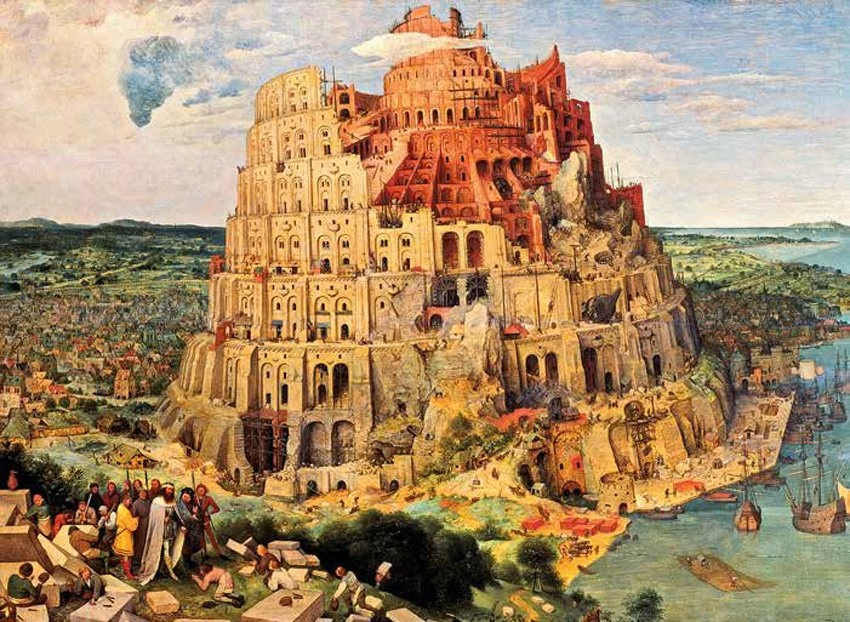
Many of the gravestones carry both Slavic and Italian texts, as if the dead hadn’t been able to make up their minds as to what and who they are. I have tried to find a pattern in this Babylonic confusion of tongues, but in vain. There is not much to hold on to, except for the fact that the dead – or their families – preferred Italian inscriptions and Italian names if we go back a hundred years or more in time. The Croatian or Slovene language gets its revenge beginning some time in the middle of the 20th century. Partly, this pattern allows for a political interpretation. Under Habsburg, no distinction was made between all the nations of the empire, which was meticulous in its effort to treat all its different peoples in the same way; in the famous definition by the Czech writer Johannes Urzidil, the identity of the Habsburgian empire was hinternational (the national, as it were, being tucked away behind your belonging to the state).
In the village in those days, people therefore called themselves whatever was simplest and most convenient, in most cases Italians. After 1918, this became even more obvious. By that time, Istria hade become a part of the Italian state and Mussolini enforced, with considerable brutality, an “Italianization” of a population that at the same time was something else than Italian. After 1945, Tito’s partisans got their revenge: Istria became part of Yugoslavia and most of the avowed Italians fled or were driven away or killed. Nevertheless, there is a clear difference between before and after 1918. After the downfall of the double monarchy, coercion or at least expectation is part of the picture of the national identity.
This is something new, and it is the state authority that now has expectations on the inhabitants in the village, and presumes that the village will define its identity in accordance with the interests of the new nation-state. From this time, what is written on the headstone is therefore not always what the dead had wished but what his or her family found most convenient to carve into the stone. This difference is absolutely decisive. Who you are is no longer something that you decide for yourself; now the state also wants to have its say.
A person’s own identity is henceforth largely determined by somebody else (I decide who is a Jew, as Karl Lueger, the mayor of Vienna, used to say already more than a century ago). But this unambiguous national identity, proclaimed from outside, necessarily violates reality. It is contradicted by most of the inscriptions in the cemetery, which are formulated in very rough Italian, Croatian or Slovene; a schoolteacher from Trieste, Zagreb or Ljubljana, as an ardent admirer of the beauty of his own language, would be very upset if he visited my Istrian village: here you won’t find any nationally-minded patriots. But this language has not been mistreated because the inhabitants of the village are illiterate, but because each of them has grown up with more than one identity – and that’s the way it has always been.
They change languages without even thinking about it, often depending on what room in their own house they happen to be in. In the kitchen they use Italian, while Croatian is more suited for the living room where the television set is. Slovene might be best for the post office or at the bank. I can hear the inhabitants of the village calling to each other in Italian out in the fields and in the vineyards, while in the evening they argue with each other in Croatian at the inn. Language to them is exclusively a tool to make yourself understood, not a matter of grammar and even less nationality, and all of them are equally versed in Italian as well as in their two Slavic languages. But in all three, precisely, in a makeshift and incomplete way, as a kind of timid guests or like someone trying to apportion his loyalty, and therefore without the uncompromising univocity that every convinced nationalist demands. What goes for languages also goes for ethnic identity, of course.
What the villagers publicly profess has a lot less to do with themselves than with what they find opportune in order to be left alone. Their “genuine” identity, however, is always far away from this public declaration and is a lot more complex than what the officials of the nation-state wish to hear. If I ask my neighbours in the village where they come from, they say “from here”. With this expression, or when they talk about “here were we live”, they do not mean a state like Italy, Yugoslavia, Croatia or Slovenia – or even Istria – but precisely our village, Sovinjak. If I ask them about their mother tongue, they will proudly enumerate four: Italian, Croatian, Slovene and “our language”. The last, “our language”, is a mixture of the three previous and completely incomprehensible to outsiders. To the horror of all nationalists, it is also the only language they speak reasonably well. Thus, only the small word “our” seems to give us an indication of who such a person really is.

Redan prenumerant?
Logga inUpptäck Axess Digital i 3 månader utan kostnad
Allt innehåll. Alltid nära till hands.
- Full tillgång till allt innehåll på axess.se.
- Tillgång till vårt magasinarkiv
- Nyhetsbrev direkt till din inbox