

Qualities that previously denoted aesthetic failure are now cited as marks of success; while the pursuit of beauty is often regarded as a retreat from the real task of artistic creation, which is to challenge orthodoxy and to break free from conventional constraints. Arthur Danto has even argued that beauty is both deceptive as a goal and in some way antipathetic to the mission of modern art. (The Abuse of Beauty.)
The repudiation of beauty derives from a particular vision of modern art and its history. According to many critics writing today a work of art justifies itself by announcing itself as a visitor from the future. It does not matter that some people regard new works as empty, ugly or pornographic. The value of art is a shock value: art exists to awaken us to our historical predicament and to remind us of the ceaseless change which is the only permanent thing in human nature .
This vision of art feeds on a one-sided diet of examples. In painting we are constantly reminded of the Salon Art of the mid-19th century – art that was not art at all, precisely because it was derived from a repertoire of exhausted gestures – and the necessary scandal of Manet, as ‘le peintre de la vie moderne’. We are reminded of the great force that was released into the world by Manet’s iconoclasm, and of the successive shocks to the system as one by one the experiments proceeded, until figurative painting was a thing of the past.
In music we are reminded of the last symphony and late quartets of Beethoven, in which the constraints of form seem to be burst asunder by a titanic power; we are reminded of Tristan und Isolde, whose shifting chromatic harmonies seem to stretch tonality to the very limit, and of the music of Stravinsky, Bartók and Schoenberg – music which at first shocked the world, and which was justified in terms used to justify the abolition of figurative painting. The old language, it is said, was exhausted: only clichés could result from the attempt to prolong its use. The new language is designed to place music in its historical context, to recognize the present as something detached from the past, a new experience which we seize only by understanding it as ‘other’ than what has gone before. But in the very moment of seizing the present we become aware of it as past and superseded.
In architecture and literature we find the same story, of art at war with its past, forced to challenge the rule of clichés, and to set off on a path of transgression. However, there is another, and neglected, history of the modern artist which is, in fact, the story told by many of the great modernists themselves. It is the history told by T.S. Eliot, in his essays and in Four Quartets, by Ezra Pound in the Cantos, by Schoenberg in his critical writings and in Moses und Aron, and by Pfitzner in Palestrina. And it sees the goal of the modern artist not as a break with tradition, but as a recapturing of tradition, in circumstances for which the artistic legacy has made little or no provision. This history does not see the pastness of the present moment, but its present reality, as the place we have got to, and whose nature must be understood in terms of a continuum. If, in modern circumstances, the forms and styles of art must be remade, this is not in order to repudiate the old tradition, but in order to restore it. The effort of the modern artist is to present the modern world, to express realities which have not been encountered before, and which are especially hard to encompass. But this cannot be done, except by revitalizing the tradition, so as to bring the spiritual capital of our culture to bear on the present moment and to show it as it truly is. For Eliot and his colleagues, therefore, there could be no truly modern art which was not at the same time a search for orthodoxy: an attempt to capture the nature of the modern experience, by setting it in relation to the certainties of a live tradition.
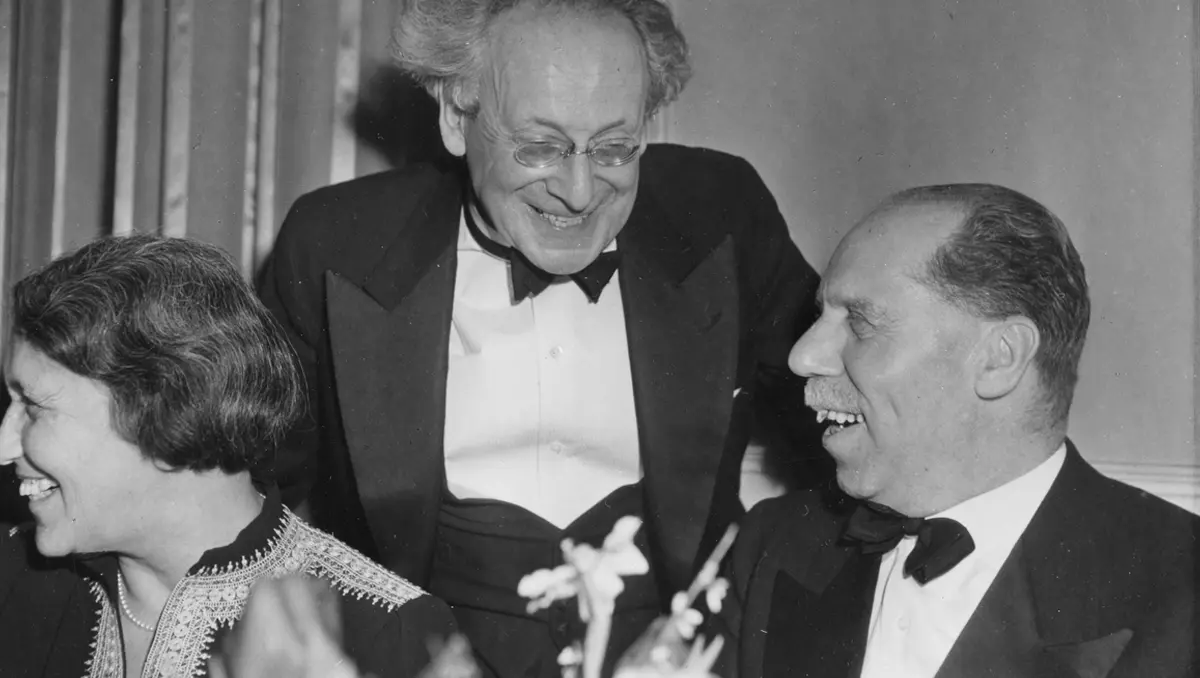
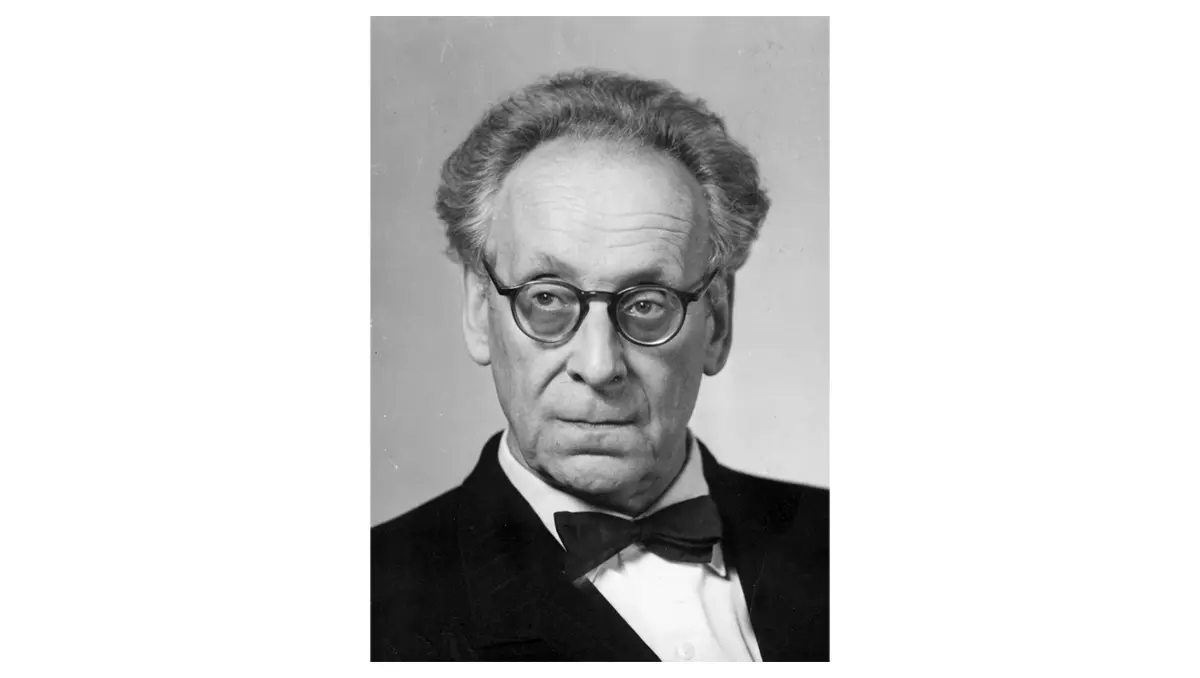
You may find the result impenetrable, unintelligible or even ugly – as many do in the case of Schoenberg. But that is certainly not the intention. Schoenberg, like Eliot, sought to renew the tradition, not to destroy it, but to renew it as a vehicle in which beauty, rather than banality, would once more be the norm. There is nothing absurd in the view that the gossamer lines of Schoenberg’s Erwartung have more of real melody than the thick textures of a Vaughan Williams symphony. True, this little melodrama has a nightmarish quality that is far from the consoling beauties of a song by Schubert. But Schoenberg’s idiom can be understood as an attempt both to understand the nightmare, and to rein it in – to confine it in a musical form which gives meaning and beauty to catastrophe in the way that Aeschylus gave meaning and beauty to the avenging furies, or Shakespeare to the dreadful death of Desdemona.
The modernists feared that the aesthetic endeavour would detach itself from the full artistic intention, and become empty, repetitious, mechanical and cliché-ridden. It was self-evident to Eliot, Matisse and Schoenberg that this was happening all around them, and they set out to protect an endangered aesthetic ideal from the corruptions of popular culture. This ideal had connected the idea of beauty with the impulse to consecrate human life and endow it with a more than worldly significance. In short, the modernists set out to reunite the artistic enterprise with its underlying spiritual cause.
I do not mean to imply that art has always been in the service of religion, or animated by some doctrinaire or sacerdotal purpose – far from it. I mean that Western art has drawn upon and amplified the experiences which form the bedrock of religion, and in doing so offered a secular vindication of a sacred view of life. And this is as true of modern art as of the art of the Renaiisance, of the Enlightenment and of the Romantic movement. Behind works such as Bergmann’s Wild Strawberries or Britten’s Peter Grimes lies the very same vision that bursts forth in full religious garb in The St Matthew Passion and The Divine Comedy – the vision of human life as possessing a value that cannot be spelled out in merely temporal terms. And even when art sets out to substitute for the religious worldview, to show us, as did Rilke and Lawrence, as here and now redeemed in our mortality, the same fund of religious emotion animates the artistic venture, looking beyond the sensuous and the expendable to a meaning that sets us in some way apart from the rest of nature and vindicates our passage through it.
Modernism was, then, a sustained attempt to recapture the tradition, and with it the old idea of beauty, as a value which stands next to the sacred and which redeems human life in something like the way that sacred things redeem it, by showing life’s more than sensuous value. Modernism was not conceived as a transgression but as a recuperation: an arduous path back to a hard-won inheritance of meaning. This is not what we see in the consciously ‘transgressive’ and ‘challenging’ art of today, which exemplifies a flight from beauty, rather than a desire to recover it. We can easily see this by studying a vivid recent example.
One of Mozart’s most endearing works is the comic opera, Die Entführung aus dem Serail, which tells the story of Konstanze, shipwrecked and separated from her fiancé Belmonte, and taken to serve in the harem of the Pasha Selim. After various intrigues, Belmonte rescues her, helped by the clemency of the Pasha, who respects Konstanze’s chastity, declining to take her by force. This implausible plot permits Mozart to express his Enlightenment conviction that charity is a universal virtue, as real in the Muslim empire of the Turks as in the Christian Empire of the enlightened Joseph II (himself hardly Christian). The faithful love of Belmonte and Konstanze inspires the Pasha’s clemency. And, even if Mozart’s innocent vision is without much historical basis, his belief in the reality of disinterested love is everywhere expressed and endorsed by the music. Die Entführung advances a moral idea, and its melodies share the beauty of that idea and persuasively present it to the listener.
In the 2004 production of Die Entführung at the Comic Opera in Berlin, the producer Calixto Bieito decided to set the opera in a Berlin brothel, with Selim as pimp, and Konstanze one of the prostitutes. Even during the most tender music, the stage was littered with couples copulating, and every excuse for violence, with or without a sexual climax, was taken. At one point a prostitute is gratuitously tortured, and her nipples bloodily and realistically severed before she is killed. The words and the music speak of love and compassion, but their message is drowned out by the loudly orchestrated scenes of murder and narcissistic sex that litter the stage.
That is an example of a phenomenon with which we are familiar from every aspect of our contemporary culture. It is not merely that artists, directors, musicians and others connected with the arts are in flight from beauty. There is a desire to eliminate beauty, to rub it out. Wherever beauty lies in wait for us, the desire to pre-empt its appeal can intervene, ensuring that its still small voice will not be heard behind the scenes of desecration. For beauty makes a claim on us: it is a call to renounce our narcissism and look with reverence on the world. (Cf. Iago of Cassio: ‘He hath a daily beauty in his life/ Which makes me ugly’.)
To desecrate is to spoil what might otherwise be set apart, in the sphere of consecrated things. We can desecrate a church, a mosque, a graveyard, a tomb; and also a holy image, a holy book or a holy ceremony. We can also desecrate a corpse, a cherished image, even a living human being – in so far as these things contain (as they do) a portent of some original ‘apartness’. The fear of desecration is a vital element in all religions. Indeed, that is what the word religio originally meant: a cult or ceremony designed to protect some sacred place from sacrilege.
Our need for beauty is not, I believe,a redundant addition to the list of human interests. It is not something that we could lack and still be fulfilled as people. It is a need arising from our metaphysical condition, as free individuals, seeking our place in a shared and objective world. We can wander through this world, alienated, resentful, full of suspicion and distrust. Or we can find our home here, coming to rest in harmony with others and with ourselves. The experience of beauty guides us along this second path: it tells us that we are at home in the world, that the world is already ordered in our perceptions as a place fit for the lives of beings like us. But beings like us become at home in the world only by paying tribute to our ‘fallen’ condition. Hence the experience of beauty also points us beyond this world, to a ‘kingdom of ends’ in which our immortal longings and our desire for perfection are finally answered. As Plato and Kant both saw, therefore, the feeling for beauty is proximate to the religious frame of mind, arising from a humble sense of harmony between the world around us and the needs within, and aspiring towards the highest unity with the transcendental.
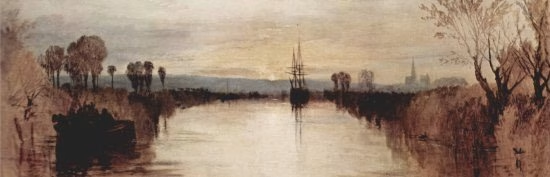
Look at any picture by one of the great landscape painters – Poussin, Guardì, Turner, Corot, Cézanne – and you will see that idea of beauty celebrated and fixed in images. Those painters do not turn a blind eye to suffering, or to the vastness and threateningness of the universe, of which we occupy so small a corner. Far from it. Landscape painters show us death and decay in the very heart of things: the light on their hills is a fading light; the walls of their houses are patched and crumbling like the stucco on the villages of Guardì. But their images point to the joy that lies incipient in decay, and to the eternal that is implied in the transient.
Desecration is a kind of defence against the sacred, an attempt to destroy its claims. In the presence of sacred things our lives are judged and in order to escape that judgement we destroy the thing that seems to accuse us. According to many philosophers and anthropologists, however, the experience of the sacred is a universal feature of the human condition, and therefore not easily avoided. For the most part our lives are organized by transitory purposes. But few of these purposes are memorable or moving to us. Every now and then we are jolted out of our complacency, and feel ourselves to be in the presence of something vastly more significant than our present interests and desires. We sense the reality of something precious and mysterious, which reaches out to us with a claim that is in some way not of this world. This happens in the presence of death, and especially the death of someone loved. We look with awe on the human body from which the life has fled. This is no longer a person, but the ‘mortal remains’ of a person. And this thought fills us with a sense of the uncanny. We are reluctant to touch the dead body; we see it as in some way not properly a part of our world, almost a visitor from some other sphere.
This experience is a paradigm of our encounter with the sacred. And it demands from us a kind of ceremonial recognition. The dead body is the object of rituals and acts of purification, designed not just to send its former occupant happily into the hereafter – for these practices are engaged in even by those who have no belief in the hereafter – but in order to overcome the eeriness, the supernatural quality, of the dead human form. The body is being reclaimed for this world, by the rituals which acknowledge that it also stands apart from it. The rituals, to put it in another way, consecrate the body, purify it of its miasma and restore it to its former status as an embodiment. By the same token, the dead body can be desecrated, when it is displayed to the world as a mere heap of discarded flesh – and this is surely one of the primary acts of desecration, one to which people have been given from time immemorial, as when Achilles drags the body of Hector in triumph around the walls of Troy.
There are other occasions when we are in a similar way startled out of our day-to-day preoccupations. In particular, there is the experience of falling in love. This too is a human universal, and it is an experience of the strangest kind. The face and body of the beloved are imbued with the intensest life. But in one crucial respect they are like the body of someone dead: they seem not to belong in the empirical world. The beloved looks on the lover as Beatrice looked on Dante, from a point outside the flow of temporal things. The beloved object demands that we cherish it, that we approach it with an almost ritualistic reverence. And there radiates from those eyes and limbs and words a kind of fulness of spirit that makes everything anew.
The human form is sacred for us because it bears the stamp of our embodiment. The wilful desecration of the human form, either through the pornography of sex or the pornography of death and violence, has become, for many people, a kind of compulsion. And this desecration, which spoils the experience of freedom, is also a denial of love. It is an attempt to remake the world as though love were no longer a part of it. And that, surely, is what is the most important characteristic of the post-modern culture, as exemplified in Bieito’s production of Die Entführung: it is a loveless culture, which is afraid of beauty because it is disturbed by love.
But we don’t have to join this loveless culture. We can, at any moment, turn away from desecration and ask ourselves instead what inspires us and what we should revere. We can set ourselves on a path along which the light of beauty shines – as we do when we listen to Mozart’s opera in the quiet of our home, so rescuing it from the grip of those who would despoil it. We can turn our attention to things we love – the woods and streams of our native country, friends and family, the ‘starry heavens above’ – and ask ourselves what they tell us about our life on earth, and how that life should be lived. And then we can look on the world of art, poetry and music and know that there is a real difference between the sacrilegious, with which we are alone and troubled, and the beautiful, with which we are in company, and at home.

Redan prenumerant?
Logga inUpptäck Axess Digital i 3 månader utan kostnad
Allt innehåll. Alltid nära till hands.
- Full tillgång till allt innehåll på axess.se.
- Tillgång till vårt magasinarkiv
- Nyhetsbrev direkt till din inbox