This yellow river came by accident to bring forth a nation identified by its yellow skin pigment. What is more, this people talk about their first ancestor as the Yellow Emperor. Today every fifth person on the surface of the Earth is a descendant of the Yellow Emperor. (Su, 1991, p. 9)
How do we explain the continued existence of racist belief systems across large parts of the globe? A common explanation – proposed, for example, by the popular historian Nial Ferguson – is that racial classifications are so widespread because they are real. Adducing new research findings on human genetics, he claims this, the “common sense” model, that human behaviour is programmed to protect one’s own kind and oppose those who belong to another race: like attracts like. Another, equally popular, explanation dismisses science as pure myth creation and instead shows that global racism marks the ideologies and structures of global capitalism. According to this “imposition model”, which is embraced by a number of people from Oliver Cox to Fidel Castro, the global division of labour produces forms of “inverse racism” in that forms of discrimination emanating from the centre are internalized and reproduced by the periphery. Even more influential is the “diffusion model” or dust-cloud theory: “Westernisation”, that is to say Western social influence, has, according to advocates of the modernisation theory, led to a diffusion of racism from Europe to the rest of the world in that prejudices are copied and assimilated locally, and force out traditional forms of discrimination.
All three explanatory models are powerful in their simplicity, but fall ultimately in that they interpret racism as a homogeneous phenomenon, as if there is only one form of racism which is universal as regards its origins, content, causes and effects. They also repeat a Eurocentric prejudice by ignoring the lasting influence of moral and cognitive traditions in Asia, Africa, America and the Middle East: they portray people as mere passive recipients of foreign ideas and phenomena. We should instead acknowledge people as active historical agents who worldwide have interpreted, adapted, transformed and even rejected racism in their own particular way. In order to understand the abiding attraction of the racist discourse one has to realise that it is far from a fixed or static phenomenon, but can adopt many different forms and be adapted to different historical circumstances.
The interactive interpretative model I am going to present here emphasises those worldviews which are constructed by local historical actors, at the same time as it will analyse the complex cognitive, social and political dimensions behind the indigenous population’s acceptance of racist belief systems. In brief, it focuses on active and creative appropriation rather than passive consumption. The interactive model, based on reception studies, is immediately confronted with a considerable challenge: if the local interpretations of racism are significant, we need detailed in-depth studies based on the local languages, something that has almost totally been neglected by the Eurocentric models mentioned above. As recently as 1992 the first systematic historical analysis of a racist belief system outside of Europe and America, with details about how racism developed, was diffused and consolidated in one specific case, that of China (Dikötter 1992; all references are to this book unless otherwise stated).
Since then material has been presented on Japan, which has confirmed the interactive explanatory model (for an introduction, see Dikötter 1997). The first important point that came to light in the study of racism in China and other parts of the world is the significance of already given cognitive and social traditions. In China, which we will be concentrating on in this short survey, the colour yellow had positive connotations long before racist belief systems were introduced from abroad. In Europe the idea of a “yellow race” probably arose only at the end of the 17th century, as a reaction to the Jesuits’ reports from China about the symbolic value of the colour yellow. The concept did not exist during classical antiquity, and was not used by mediaeval explorers like Marco Polo, Pian del Carpini, Bento de Goes or Arab traders. In 1655 the first European expedition to Qing described the Chinese as having white skins, with, “similar skin to Europeans”, apart from some inhabitants of the South whose skin was “light brown”. The first scientific work in which the concept of a “yellow race” appeared was François Bernier’s Etrennes adressées à Madame de la Sablière pour l’année 1688 (Huard, 1942). It should be added that the term “yellow” in China was associated with very strongly positive signification.
Yellow, one of the five “pure” colours, had long connoted Imperial dignity and symbolised the Middle. It was the colour for the Emperor of the Middle Kingdom, the original home of the “Yellow Emperor’s descendants”, who were assumed to originate from the valley of the Yellow River. The government supporter Wang Fuzhi (1619-92), whose influence stretches right up to the beginning of the 20th century, gave one of his earlier works the title The Yellow Book (Huangshu, 1656). In the final chapter the Imperial colour yellow was contrasted with “mixed” colours and China was denoted as the “yellow centre”. Among the people legends circulated about the origins of mankind in which noble individuals (liangmin) were created from yellow clay, and ignoble people (jianmin) from simple rope. Huang Zunxian (1848-1905) noted in his diary at the age of 20 that “everyone is made from yellow clay”. At 55 years of age, as one of the leading reformers during the late empire and an important advocate of racial theories, he asks the open question: “Why is the yellow race not the only race in the world?”
Even at other levels once can find strong resonance between indigenous society’s world pictures and racist belief systems: the key example is the patrilineal tradition. The final dynasty, founded in 1644, was marked by a consolidation of the patrilineal cult, as a centre for a broad social reform movement in which there was an emphasis on the family and the clan (zu). Throughout the 19th century were great tensions between different clans, as a result of greater competition for natural resources, the need to control commercial centres, the gradual undermining of social order, and disturbances in the organisation caused by demographic pressures. Militarisation of strong clans confirmed popular ideas about clan solidarity, which in its turn forced more loosely organised groups to form a common federation based on ancestry under the leadership of the nobility.
Even at the level of the court, ideologies about descent became increasingly important, particularly through the undermining of the feeling of cultural identity among Manchu aristocrats – the founders of the Qing dynasty in 1644. Pamela Crossley has shown how group identity through patrilineal descent became important during the Qianlong period (1736-95), when the court gradually developed a proper classification of different clan lines (zu) in order to distinguish between the Han people, Manchus, Mongols and Tibetans (Crossley, 1990). At three different levels of society – within popular culture, the society of the nobility and court politics – one and the same concept of patrilineal descent came to be applied on a large scale in order to create and maintain the boundaries between different groups.
But even if these different cognitive traditions, social groups and political structures were vital, they were not sufficient to lead to the formulation of a racist belief system. Racial theories became possible first through the growth of scientific knowledge in Europe from the late 18th century, when science offered a whole new view which for the first time made it possible to think systematically about the relationship between culture and biology. Through racial theories, first in parts of Europe and eventually in other parts of the world, an attempt was made to explain cultural differences as natural differences, and portray social groups as biological units: racial theorists commandeered science, from craniology to genetics, in order to get those boundaries they had constructed between different groups to appear to be objectively based in natural laws.
Worldwide one can find negative attitudes to the physical appearance of individuals or population groups even before the modern era, but these attitudes seldom formed a coherent system which could legitimise social incorporation or exclusion. A racial belief system arose in China only with the reform movement which developed after the country’s defeat in the war with Japan in 1894-95. Leading figures such as Liang Qichao (1873–1929) and Kang Youwei (1858-1927) appropriated scientific knowledge selectively from foreign sources in order to create a new feeling of group identity. In their striving for riches and power after the country’s military defeat, and with the need for a unifying concept which could bring all of the Emperor’s subjects together into a mighty nation strong enough to resist the foreign invasions which had begun with the first Opium War (1839-1842), the reformers used new evolutionary theories from Great Britain to portray the world as a battlefield in which different races struggled to survive.
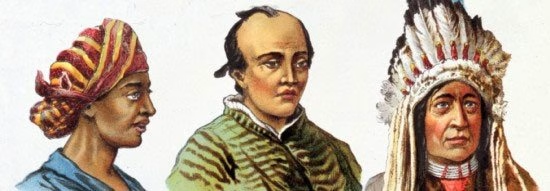
They also adduced the patrilineal culture in order to portray all of China’s population as descendants of the Yellow Emperor. With its starting point in the indigenous experience of clan feuds, which characterised the social climate of late imperial China, the reformers have constructed a racially-oriented world picture, in which “yellow people” competed with “white people” for power over the degenerate races of “brown”, “black” and “red” people. The concept of “race”, which was favoured by its relationship to thinking on heredity, gradually came to become the most common symbol of national unity, permanently replacing more conventional emblems of cultural identity. The threat of the extinction of the race (miezhong), an effective terror propaganda based on a more popular concern about clan extinction (miezu), was often adduced to back up the reformers’ message of change when faced with imperialist aggression: “They will enslave us and prevent our physical and spiritual development… the brown and black races are constantly hovering between life and death: why should the 400 million yellow people not do so?” In the reformers’ symbolic network of racially-determined “others”, the dominant “white” and “yellow races” were contrasted with the “darker races”, which were doomed to die out because of their hereditary inadequacy. The social hierarchy between different ethnic groups in the Empire was expanded to the notion of a racial hierarchy characterised by “noble” (guizhong) and “ignoble” (jianzhong), “superior” (youzhong) and “inferior” (liezhong), “historical” and “unhistorical races (yolishi de zhongzu).
The distinction between “ordinary people” (liangmin) and “common people” (jianmin), which is widespread in China up to the late 18th century, found an echo in Tang Caichang (1867-1900), who contrasted “noble races” (liangzhong) with “ignoble races” (jianzhong). He expressed his view in well-turned phrases which bear witness to his classical education: “The yellow people are wise, the red and black stupid; the yellow and white are masters, the red and the black slaves; the yellow is united, the red and the black are divided.”
Out of the combination of science and nationalist politics a vision developed of racial renewal. The reformers put forward proposals for a form of constitutional monarchy which would include the Manchu emperor: their concept of a “yellow race” (huangzhong) was sufficiently broad to comprise all of the inhabitants of the Middle Kingdom. Along the lines of the failed Hundred Days Reform of 1898, which ended when the Dowager Empress rescinded all reform decisions and executed several of those officials who had promoted reform, a number of radical intellectuals began to advocate the overthrow of the Qing dynasty.
Not without certain echoes of the political revolutions in Europe in 1789 and 1848, the anti-Manchu revolutionaries depicted the ruling elite as an inferior “race” responsible for a catastrophic policy which had led to the country’s decline, whilst the greater part of the population of China were regarded as belonging to a homogeneous race, the Han people. The very concept of the Han people as a specific race developed in the context of resistance both to the foreign powers and to the ruling Manchus. For the revolutionaries the concept of a “yellow race was not quite adequate, as it included the hated Manchus. Whilst the reformers regarded race (zhongzu) as a biological extension of the clan (zu), comprising all of the people within the territory of the Yellow Emperor, the revolutionaries excluded Mongols, Manchus, Tibetans and other ethnic groups from their racial definition, which was restricted to the Han people, who were described as a minzu.
Minzu, a key term which after 1949 was used interchangeably with both “ethnic group” and “nationality”, referred to a group with common descent with a particular culture and a particular territory.
During the initial period from 1902 to 1911, when the Qing Empire collapsed, the term minzu was used to emphasise symbolic bloodlines and lines of descent: “nationalities” as political units were compared with “races” as biological units. In the nationalist ideology during the first decade of the 20th century minzu was thought of as based on a particular group of people called “Han”, clearly defined by virtue of a presumed common ancestry. Sun Yatsen (1866-1925) became one of the foremost advocates of a Chinese minzu, which he maintains was kept together primarily by a “common blood”. Minzuzhuyi, or “the teaching of minzu”, became the term used to translate the ideology of nationalism into modern Mandarin, which clearly shows the overlap one imagined between nation and race. Nationalism was the first principle in Sun Yatsen’s “Three Principles of the People” and has subsequently been adopted by both the Guomindang (The Chinese National People’s Party) and the Chinese Communist party.
Whilst the racist belief system at the end of the 19th century was therefore developing in connection with resistance both to Manchu rulers and foreign powers, it has from time to time been revived throughout the 20th century. After Deng Xiaoping’s accession to power in 1978 the language of science gradually began to replace communist ideology in the majority of politically sensitive areas. With palaeoanthropology one can see how race and nation coincided in scientific research in the 1980s and 1990s (the two sections following are based on Dikötter 1998). Leading researchers have portrayed Peking Man at Zhoukoudian as the “ancestor” of the “mongoloid race” (Menggu renzhong).
A large number of hominid teeth, skull fragments and ape fossils have since 1949 been discovered at different excavation sites across the whole of China, and these finds have been used to support the view that the current “yellow race” (huangzhong) is in direct line of descent from their hominid ancestors in China. Even if palaeoanthropologists in China acknowledge that the evidence in the form of fossil material so far discovered points to Africa as the cradle of humankind, highly respected researchers such as Jia Lanpo have repeatedly stressed that the real origins of humankind should be located in East Asia. Wu Rukang, similarly one of China’s most respected palaeoanthropologists, came very close to defending a polygenic thesis (the idea that humankind has several different origins) by drawing up different geographical areas for the “yellow race” (China), the “black race” (Africa) and “the white race” (Europe): “Those fossils of homo sapiens found in China all clearly show the characteristics of the yellow race (…) which points to the continuity between them, the yellow race and the Chinese people of today.”
Serological studies have also been carried out to emphasise the biological affinity of all of the minorities to the Han people. Estimates of genetic distance based on gene frequency, primarily carried out on the initiative of Professor Zhao Tongmao, are said to have determined that racial differences between ethnic groups in China – including Tibetans, Mongols and Uigurs– are relatively small. Zoologists have also stated that the “negroid race” and the “Caucasian race” more closely related to each other than they are to the “mongoloid race”. Zhao Tongmao places the Han people right in the middle of his map, with bifurcations which gradually arrange the other minority groups of China into a tree which emphasises the genetic distance between “yellow people” on one hand and “white people” and “black people” on the other. In his summary, he emphasises that the Han people are the main branch of the “yellow race” in China, to which all minority groups can be traced back: the political boundaries for the People’s Republic of China in other words seem to be based on clear biological markers of genetic distance.
In a similar way the skulls, hair, eyes, noses, ears, entire bodies and even sexual organs of thousands of individuals are routinely measured, weighed and assessed by Chinese anthropometricists trying to identify “the characteristic features” (tezheng) of the minority peoples. To take just one example, Zhang Zhenbiao, a notorious anthropometricist who writes in the prestigious Acta Anthropologica Sinica, draws the following conclusion from the measurements carried out on 145 Tibetans: “To summarise: the results of this study of characteristic features of contemporary Tibetans’ heads and faces shows that their heads and faces are similar to those of several other nationalities in our country, particularly in the country’s northern and north-western parts (including the Han people and national minorities).
There is no doubt that the Tibetans and other nationalities in our country are descended from a common origin, and as regards their physical characteristics, and belong to one and the same East Asiatic type of the yellow race [huangzhongren de Dongya leixing].” Whilst scientific knowledge is used to construct a theory of common descent, the dominant Han people are presented as the core of a “yellow race” which at its margins comprises all of the minorities. Within both scientific institutions and government circles different ethnic groups in China are often presented as one group with relatively homogeneous origins traced back to the Yellow Emperor. Today’s China is, in short, not primarily a “civilisation pretending to be a state”, in Lucien Pye’s words (Pye, 1994, p. 58), but rather an empire with aspirations to being a race.
Several elements appear fundamental in the local formulation of a racist belief system. Primarily we have the credibility of the racial discourse gained from science as a system of organised study of the natural world from the end of the 18th century: if science could produce steamships and predict the movements of the heavenly bodies, could it not also in an equally effective way be uses to divide up humankind into different biological groups? Whilst the prestige of science was decisive for the successes of the racial discourse, there was such a superabundance of internally incompatible theories that almost any attitude at all would be justified in the name of science. In France and China, for example, soft interpretations of heredity were more popular than the hard language of genetics, as they made it possible to portray “race” as a flexible rather than an inflexible entity, with the possibility of change for the better – an idea based on neo-Lamarckianism rather than neo-Darwinism.
Just as important was a new policy of equality. Whether we talk about independence in the USA in 1776, the revolutions in Europe in 1848, or the Manchu revolution of 1911, the nationalists attempted to demolish internal boundaries, often but not always based on lineage (royalty, mobility, aristocracy) in order instead to construct external boundaries between peoples defined as nations, and this was often done by portraying them as biological units in terms of “race”. But even certain elements of cognitive continuity were significant, as new race vocabularies often had a greater impact in a cultural environment prepared to emphasise real or experienced physical differences between people. This was, for example, the case with the significance of the colour yellow and the dissemination of patrilineal forms of social organisation in China.
A counter-example may illustrate the point: according to MacGaffey (1972) the traditional cosmology among the BaKongo, an ethnic group living on the Atlantic coast of Africa, was based on a complementary opposition between this world and the hereafter. They believed that the skin of dead people was white when they crossed the waters to be united with the spirits in the other world. When Europeans first came into contact with the BaKongo people, the latter thought that the newcomers had come from out of the water which they used at night to sleep. This amalgamated world picture meant that the BaKongo people did not distinguish between civilisations in racial terms, which prevented the origin of a sharp distinction between European culture and the BaKongo’s own cosmology. As a result of this the symbolic universe of the Congolese was remarkably resistant to decades of concentrated colonial influence, including the racist machinery maintained by missionaries and representatives of the Empire.
Racist belief systems are, therefore, a global phenomenon, even if they are neither homogeneous nor universal. They are united by a common language taken over from science and a common politics based on a vision of equality within one’s own race, but they can also vary strongly depending on local cognitive traditions and the political context: it is precisely this flexibility that is one of the reasons why the racial discourse has come to be used in so many different historical contexts. This feature also explains its survival across large parts of the world even in our times, reinforced by constantly new concepts borrowed from science, with gene technology and the Human Genome Project as the most recent examples.
References:
Crossley, Pamela Kyle, 1990, “Thinking about ethnicity in early modern China”, Late Imperial China, 11: 1, p. 1-35
Dikötter, Frank (ed.), 1997, The Construction of Racial Identities in China and Japan: Historical and Contemporary Perspectives, London: C. Hurst; Honolulu: University of Hawaii Press
Dikötter, Frank, 1992, The Discourse of Race in Modern China, London: Hurst; Stanford: Stanford University Press
Dikötter, Frank, 1998, “Reading the body: Genetic knowledge and social marginalisation in the PRC”, China Information, 13: 2-3, p. 1-13
Huard, Pierre, 1942, “Depuis quand avons-nous la notion d’une race jaune?”, Institut Indochinois pour l’Etude de l’Homme, 4, p. 40-1
MacGaffey, William, 1972, “The West in Congolese experience”, in P. D. Curtin, Africa and the West. Intellectual Responses to European Culture, Madison: University of Wisconsin Press, p. 49-74
Pye, Lucien W., 1990, “China: Erratic state, frustrated society”, Foreign Affairs, 69: 4, p. 56-74
Su Xiaokang, 1991, “River Elegy”, Chinese Sociology and Anthropology, 24: 2, p. 9