Sometimes I walk past the graves of the Johannes Cemetery. I stop by Georg Carl von Dobeln’s grave and reflect upon his motto: Honour, Duty, Will. Another Sweden, another time. It also happens that I linger at the memorial stone to the victims of Stalin’s murder of thousands of Polish officers in Katyn in 1940. Also another time. The fresh flowers remind us that the time is not far away, and also that the world in our time is not the tranquil one for which we had hoped when the Berlin Wall fell, the Cold War ended, and the Soviet Union ceased to be.
It is precisely this naive vision of the future that underpins the foundation of Swedish defence and security policy, at least in terms of our part of the globe – during the hopeful 1990s acid era, eternal peace was proclaimed.
As we enter 2013, no one really counts on the EU’s soft power any longer, but rather we ponder the trends towards disintegration, social unrest and nasty forms of nationalism. NATO has problems with members’ disarmament, while the U.S. turns its focus to Asia. Russia wants to restore its former superpower status, and is pressuring its neighbours and making preparations.
Meanwhile, the hollowness of Swedish defence and security policy is laid bare. Here and now became the motto of a defence policy with usability as its guiding organisational principle. The Swedish armed forces have proven their usefulness in Afghanistan, the Gulf of Aden and Libya, but what else can they be used for other than emergency operations in faraway towns?
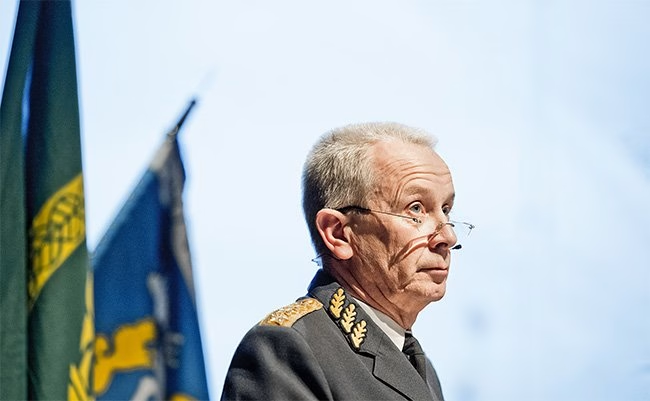
The answer from the Supreme Commander, Sverker Goranson, in a SvenskaDagbladet interview on New Years Eve is that it is not more useful than that Sweden – in a realistic scenario – could not hold out for more than a week on its own. Then we need help.
The Supreme Commander also spoke not about the here and now, but looked forward to a possible situation in 2019 (under the conditions that it is possible to recruit to the new military and that the government contributes 3-4 billion kronor per year from 2015 to 2019). If one were to judge by the political defence rhetoric, one might think that the whole of Sweden is defended, but in reality it has been shown that the ability in 2019 will be just enough to concentrate efforts in one of the five priority areas. If the choice is Stockholm, then Skane, Gothenburg, Gotland and Norrland will be left to their fates.
In a study from The Royal Swedish Academy of War Sciences it has been shown that even one week is optimistic. There is a shortfall in terms of capability; this includes air defence and also such as the inability to provide troops with food and ammunition. A bridge system is missing, which makes it impossible to cross streams. And so on.
The Supreme Commander was also overly optimistic in his New Year interview. When the counter had finished jingling at headquarters, the result was a requirement for an appropriation gain of approximately 40 billion kronor spread over 10 years so it should be possible to deliver in 2023 the defence that parliament decided on for 2009. The alternative is to completely remove the capabilities or reduce the war organisation.
‘We build security together with others’, is the basic security policy foundation on which defence policy rests. In Sweden’s unilateral Solidarity Declaration, it states that we are to give and receive military assistance. In reality, we are largely lacking this ability. After the speech by NATO Secretary General, Anders Fogh Rasmussen, held at the National People and Defence Conference in Salen, there also can be no doubt about where NATO stands: Sweden cannot automatically count on help from NATO. The security guarantee is restricted to members. Neither can Sweden find support in the Lisbon Treaty provisions on the obligation of member states to provide military assistance. Europe lacks the ability and is not developing it.
A week in one part of Sweden. No guarantees of help and, in the event it comes, an inability to receive it; with these things Defence Minister Karin Enstrom has declared herself satisfied. Prime Minister Fredrik Reinfeldt, for his part, declared that defence is a special interest.
One week’s defence meets neither the minimal state’s requirements for state power nor the requirement that international law imposes that a state should be able to assert its territorial integrity. It cannot, in any meaningful sense, be said to be in accord with the officially stated objectives of security policy ”to preserve Sweden’s peace and independence, contribute to stability and security in Sweden’s neighbouring countries and strengthen international peace and security”.
Sweden needs to think about how to find the path that best serves its national interests. What is the world that awaits – far away or close? How to design a defence and security policy that extends beyond next week?
Mr. President, this is the future world to which you have to relate. The mission of the National Intelligence Council is to make a future assessment for the president-elect. After the re-election victory last autumn, Global Trends 2030: Alternative Worlds landed on Obama’s desk in the Oval Office.
Here four ”megatrends” or basic factors are identified that, it is believed, will affect the development of all possible scenarios; for example, an aging population and increased competition for food, water and energy. In addition to these trends, factors with a great potential force for change (‘game changers’) are identified, depending on how they develop; they are about the economy, state-power capacity, increased conflicts within and between states, regional instability and technological development.
One conclusion is that America’s time as dominant on the world stage will definitely be finished – while China’s power grows. In the new multi-polar world, the U.S. will still be the leading power, but will be increasingly dependent on support to lead – but how and with whom? And what are the consequences of Russia being pointed out as a possible cause for concern? These are fundamental questions also for Sweden.
Increased global uncertainty is the picture that emerges from global analyses from such as the armed forces, the Swedish Defence Research Agency and the Swedish Civil Contingencies Agency done in support of the Defence Commission’s work. The reports add up to a long list of uncertainties, risks and threats, which are linked to individual states, geographical regions, shifts in power, asymmetric threats, climate change and flow sensitivity.
The armed forces emphasise ecology, politics and functionality as key to understanding the future, and to these are connected a number of trends. In conclusion, what is likely waiting is ”increased global competition, turbulence and instability”. The ”security environment becomes more unpredictable” and ”traditional power politics” increases.
In the new world that is emerging, it is becoming even clearer that Sweden has interests far away. If Iran, in a conflict situation, closed the Strait of Hormuz, it has not really anything directly to do with Sweden, but it would have a great economic and geopolitical impact on Sweden. Our scope of interest is also more varied than before. EU membership means that the turbulent Arab Spring is unfolding in what also has become our neighbourhood.
Similarly, other states’ interests are close to us. Climate change means that China has become a player – in both economic and security interests – on our Arctic ‘doorstep’. An overall conclusion is that the era of optimistic multilateralism that characterised the post-Cold War era is over. Not that multilateral fora have become unimportant, but rather the geopolitical dimension has once more become central. As far as Sweden is concerned, the central geopolitical challenge of the emerging risk scenario involves Russia.
The case of the Russian lawyer, Sergey Magnitsky (who is on trial posthumously accused of the scam he himself revealed), who was murdered in prison, and the sentences against members of Pussy Riot can both be used as a litmus test for what kind of state Russia is: a ‘democratorship’. Democracy is merely a backdrop and the judiciary a black farce. Developments during the Putin era have become more authoritarian and, after the Russian Spring (protests against fraud in the parliamentary elections of 2011 and the presidential elections of 2012), repression has accelerated. One example is that human rights organisations that receive financial support from outside the country – under the threat of prison – must register as a ”foreign agent”. The law will make it more difficult to receive support, but it is also a way to convey the message that organisations defending human rights in Russia are actually spies and agents of foreign powers.
If evidence of illegality is required, there will probably not be any problem finding it; the security service, FSB, can arrange everything. The ongoing trial of opposition leader Alexei Navalnyj is an example; it is also possible to build an indictment on completely absurd evidence. Power utilises Lady Justice to create a legal basis for keeping the opposition in check.
Russia’s dilemma is, on the one hand, that the clans around Putin cannot implement the sweeping political and economic reforms that are needed and, on the other hand, that the power elite does not want to step aside. At the same time, popular discontent with the corrupt regime is on the increase.
Russia is stuck in a dead end.
It is, as Lily Sjevtsova at the Carnegie Foundation in Moscow has put it, a system in disrepair. She does not rule out that the regime can rearm itself through a new leader, but stresses that it is only a matter of time before it will be challenged in earnest. Admittedly, the opposition is fragmented, but it is not impossible it can present an alternative to appeal to a wider public opinion, especially if falling energy revenue leads to state finances become unsustainable. However, it is the left and nationalists, rather than liberals, who will take the lead.
Increased repression in combination with slow decay is a near future scenario; another is crisis and rebellion. It is also against this background that one should see the regime’s alliance with the Orthodox Church – the cultivation of a nationalist ideology with a uniquely Russian civilisation at the centre, and the propaganda image of a threatening external world.
President Vladimir Putin has repeatedly stated that Russia must prepare to face attempts to alter the global balance of power. He uses as examples the enlargement of NATO and the U.S. missile defence that is directed against Iran. In the Russian defence doctrine, there is a distinction between risk and threat. NATO is a risk (although Russia is a partner of NATO).
Deputy Prime Minister Dmitry Rogozin, who is also the armament minister, has emphasised that ”the threat of military force is still the most important factor in solving political and economic conflicts in the modern world”. To decisively defend peace and Russia’s place in the world, it needs to ”act with a steel hand hidden in a velvet glove”.
The defence minister and general, Sergei Sjojgu, has emphasised that the use of violence continues to play an important role in solving economic and political differences between countries. He has also stated that there are ”hot spots” near the Russian border. Chief of the General Staff Valery Gerasimov – and the deputy prime minister – have warned that the military threat to Russia will increase significantly by 2030.
This is an example of rhetoric that fits into the nationalist ideology that has replaced ‘modernisation’ as a legitimacy-building message. It reveals, however, also the ruling elite’s Weltanschauung. The underlying idea behind the foreign policy worships the use of force as an instrument of foreign policy. Correspondingly, it similarly respects others’ strength. The statements also illustrate how one sees the significance of displays of military strength. It is a way to create an identity of a great power and confirm the status as such.
In what can be described as the Russian strategic culture, there is also included the idea of ??a Russian ‘sphere of influence’ in which no one else should interfere. The culture also includes the idea of ??‘external threat’ and an approach to international politics as a zero-sum game. In a speech in March, Putin explained the Soviet attack on Finland in 1939 as an attempt to correct the mistakes made after the October Revolution. According to Putin, it was about correcting the borders so that St. Petersburg (then Leningrad) could not be threatened. He forgot to mention about the quisling government under Otto Ville Kuusinen (the Terijoki regime), that was established on the first day of the war and which was supposed to be installed in Helsinki.
That boundaries can be redrawn through violence has a more recent example in the war in Georgia in 2008. In this perspective, there are also reasons to consider the worth of the agreement between Norway and Russia on the borders in the Barents Sea, since Putin criticised this as being to the detriment of Russia – and blamed Prime Minister Dmitry Medvedev for it.
In terms of the Arctic picture, Russia is now warning of a militarisation. The Kola Peninsula’s strategic location has become more important for Russia and the arsenal of nuclear weapons is increasing.
The projection of power in the north has also meant increased flight activity around Iceland. The same pattern can be seen in the Baltic Sea region, in particular training activities, including simulation of the taking of foreign territory. Judging by the former Chief of the General Staff Makarov’s statement in Helsinki last year, Finland is seen as part of the Russian sphere of influence.
Russia is now reorganising its defence and is investing 500 billion euros in upgrades to 2020. But, it may be objected, Russia is starting from a low level. True. As a result of corruption and industrial scarcity, it is said, the plans will not be achieved in full. This is also true. But this perspective should also bear in mind that the result will nevertheless be a strong capacity building and that there is an already admitted capability. Russian defence reform is geared to meet the different types of risk scenarios in different geographical directions. In the West, Sweden’s neighbouring countries, there are already fewer but more specialised troops with high mobility and in their capacity as peace units can, without conversion (the preparedness is counted in mere hours), deliver operational capability. This is based on an idea that emphasises the importance of not only the initial phase of the war, but above all the first-strike capability and preventive attacks.
Iskander missiles, which can be fitted with conventional or nuclear warheads, and which are seen both as an offensive and defensive system, have been stationed outside of St. Petersburg. The range is sufficient to target the three Baltic States and most of Finland. The missiles can easily be relocated and then reach large parts of Sweden. S-400 missiles have been deployed in Kaliningrad with a capability to obstruct or perhaps even prevent an opponent’s air operations over the Baltic Sea. The threat that Iskander will also be deployed in Kaliningrad is heard occasionally.
Meanwhile, Sweden’s capacity – and NATO’s readiness – is low. The three Baltic states are, therefore, no safe shield. There is also the small consolation that the starting point for the Swedish defence planning is that there will not be a single attack against Sweden, but in such cases it will be part of a larger conflict. Swedish territory will have to be used by NATO in the event of a conflict with Russia, and Gotland is also a key to the control of the Baltic Sea.
I continue the holiday. It was Tage Erlander’s reaction at the time when the world had never been closer to nuclear war than during the Cuban missile crisis in 1962. Judging by the prime minister’s diary notes, he did not understand at all what was at stake. Neither did he realise how the threat of the installation of Soviet nuclear weapons on the island looked, but laid the blame on President Kennedy (“election manoeuvring”).
What does Sweden’s prime minister see in 2013? For Fredrik Reinfeldt, a one-week defence is not a worry. Sweden’s military endurance is not even a discussion that he feels needs to be completed. There is, today, no military threat to Sweden from Russia. The threat consists of political will and ability. Even if there is no will, Sweden needs to respond to the Russian military build-up in our neighbourhood. Policies can be changed quickly, but it takes years to strengthen our defences.
In a time of increased global uncertainty, we have the greatest opportunity to make a difference in our own neighbourhood. Sweden can and does already participate with Russia in various foreign policy cooperation forums. It can and should additionally do this through strengthening the national dimension of defence policy and NATO membership.
Defence and security policy should support each other, but they now serve rather as weights instead of anchors. It requires a more realistic policy. In the words of the British journalist, Bernard Levin: “The future is not what it has been.”