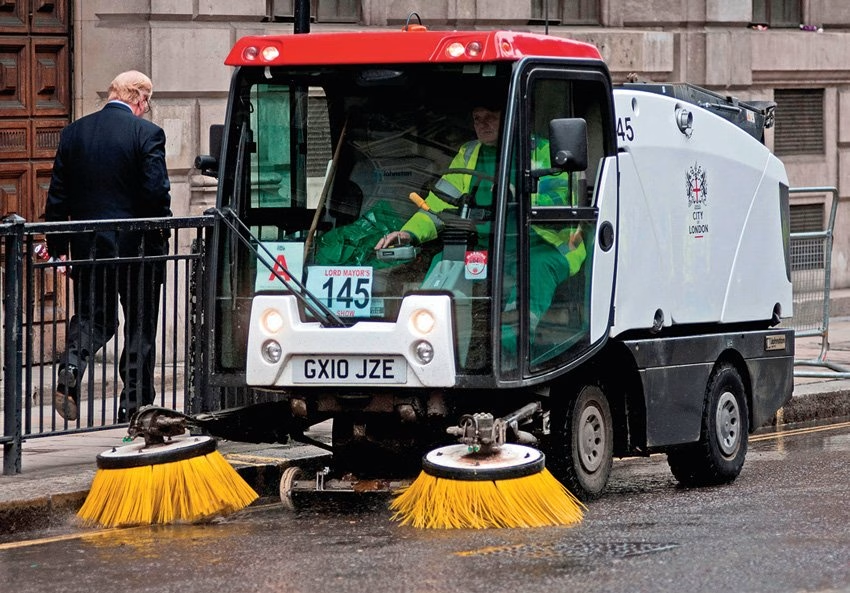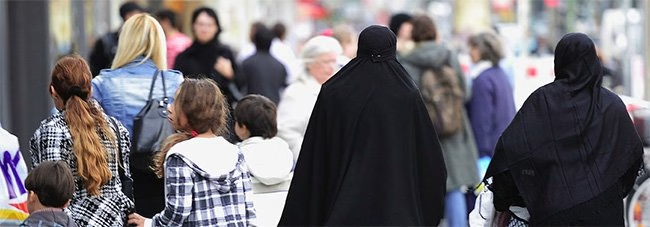


Merton is a good place to take the pulse of multi-ethnic Britain. This unpretentious neighbourhood in south-west London, with about 200,000 inhabitants, is divided between the affluent Wimbledon – famous for its tennis tournament – and the poorer areas of Mitcham and Morden. Morden is located at the end of the tube line, and thus combines access to jobs across London with homes at relatively affordable prices – this is why the district has been a magnet for minorities over the past two decades.
Not so long ago, the district’s poorer parts were full of plumbers and craftsmen. But Merton’s minority population has increased from about 10 percent in 1980 to over 50 percent today. Merton’s primary schools, which as late as 2003, had a majority of white Britons, now have 70 percent ethnic minorities. Merton has, in the usual jargon, become ”super-diverse”.
As with the UK as a whole, the newcomers mostly come from southern Asia, Africa and Eastern Europe. Some do well, others not so well, but there is not much to suggest that a common life is being set up within the current population.
This can be studied on the weekends in the little park Mostyn Gardens, five minutes from Morden tube station. On a sunny day, the park is usually full of people divided along ethnic lines: groups of Pakistani women on a picnic with their young children, Poles who drink beer, young Indian men who play cricket, Africans who play basketball.
Merton is not as segregated in terms of housing or education as some cities in northern and central Great Britain, for example, Bradford, Oldham and parts of Birmingham. But, as in many parts of the UK with a large proportion of immigrants, this has been a matter of adaptation rather than integration. The white population in places like Merton, especially in the poorer parts, has reluctantly slid aside and let others sit down on the bench.
After fifty years of significant immigration in Europe, mostly from poorer or more traditional societies, we must consider the situation and look at the history of integration and segregation in the continent as a whole. It has a varied history, shaped by different national traditions – such as British multiculturalism versus French republicanism – as well as the different minorities and the different periods during which they arrived. My comments are based on the British experience, but I hope they can have a wider application.
The question of integration and segregation is a cumbersome and complex subject where we tend to have conflicting instinctive beliefs: on the one hand, we understand that people often prefer to live in areas dominated by people like themselves; on the other hand, we feel that a good society is one where people socialise comfortably with other citizens (of all kinds), which usually requires a certain level of contact and communication.
In a liberal society, integration cannot be forced, but it can be pushed in the right direction – for example by controlling the schools’ recruiting or making language learning available. And the results of the 2011 UK Census have underlined how important these pushes actually are. Although the survey contains some optimistic stories about increased contact across ethnic boundaries – in 12 percent of households with more than one person, there are now people from more than one ethnic group – it also highlights the fact that a well-bred apartheid is being emerging in some parts of the country.
This is most evident in London, where white Britons now constitute a minority (from 60 percent in 2001, to 45 percent in 2011). Most experts had not expected this for about 20 or 30 years, and the reason they missed it is that no one noticed how quickly white Britons were fleeing from the outer boroughs such as Barking and Dagenham (which lost a third of their white British population of 10 years), Redbridge and Enfield. A total of 23 of London’s 33 boroughs now have a ”majority of minorities”. There are many reasons why people move apart from the discomfort that their neighbourhood is changing – schools, house prices, fresh air, and so on – but considering the transformation that has taken place and how fast it has been, it is hard not to see ‘white flight’ as part of the explanation.
Many white British Londoners move only a few kilometres, to the whiter areas such as Essex or Kent. Essex is now 91 percent white British, while the neighbouring Redbridge is only 34 percent. And this is not just a London phenomenon: there are similar ‘ethnic divisions’ between other neighbouring municipalities, such as Bradford/North Yorkshire and Leicester/Leicestershire. The risk is that parts of the UK in the long-term could become as polarised as many American cities.
But why is the political and academic establishment not more concerned about the issue of integration? European conservatives have generally been against high immigration levels, and have therefore not wanted to think through the consequences. Liberals, on the other hand, have embraced multiculturalism and therefore believe that this is no longer a question – either because immigration does not change society, or that the only problem is the discrimination of the host country.
But to start from a perspective where minorities are primarily victims is to overlook the complexity of these issues, particularly as the open racism has decreased in most of our communities. A more useful framework is that of the 1920s, developed by the American sociologist Robert Park, who thought that the relations between the immigrant community and the host country went through a pattern of three generations: an ”evasive” first generation, with no language or cultural skills to get involved in the host country and which anyway is often met with closed doors; the second generation’s ”engagement” and conflict, with the requirement that the host country will open its doors; and the third generation’s ”adaptation”.
Today, integration is generally regarded as the golden mean between separation on the one hand, and on the other hand, assimilation (in which minority identities and traditions are abandoned).
A high degree of separation was the norm in the early post-war immigration to Britain; it was imposed on newcomers in terms of both housing and jobs, whether they wanted it or not. But how do we measure the progress towards integration that has been achieved since then?
First, we need to have some sort of definition. Those who are suspicious of the idea of ??integration, ask what it actually means to be ‘integrated’. In a complex, liberal, open society, there is of course no simple ‘thing’ to which people can connect. But that does not mean that there is not anything at all.
Convinced multiculturalists argue that integration of minorities is not necessary, and that a good society can accommodate many different groups with very different lifestyles and values. And if an effort towards integration is needed, it should come as much from the majority of the new minorities. But citizens in modern democracies have ‘occupier rights’: beyond treating newcomers fairly, they have no obligation to change; it is the immigrant who has chosen to join an existing community and the immigrant that must bear the burden of the adjustment that a good life requires.
The easiest way to see integration is in terms of a convergence between immigrants and natives. To what extent and how quickly have they become more like us? This is complicated by the fact that there are many different forms of convergence as well as different sides of the ‘us’ with which it is possible to converge. But while the convergence of the results is an obviously important aspect, ‘rendered’ integration must be complemented by something else – something you could call ‘lived’ integration. The commonsense version of this is ”buying local newspaper and supporting the local football team”. This is too specific and prescriptive, but captures the spirit of it. To put it more abstractly, it’s about becoming effortlessly participatory in the common life and conversation in the place where you live – and thus in the country as a whole.
This is about the neighbourhood, the schools and workplaces, common spaces and languages; it is not about being represented to the ‘official’ UK by representatives of their ethnic group. It is also about immigrants having the time to familiarise themselves with the environment and become familiar with those who are already there, which is dependent on regular interaction with them – something that is difficult to achieve if you live in an ethnic enclave.
In a liberal society, people cannot be forced to integrate. And neither do they need to be integrated in all areas of life. Integration is not a question of ‘all or nothing’. Individuals and groups can be completely separated in one area of ??life and belong to the broad society in another. Sikhs and Jews, for example, tend to be quite segregated in residential terms, but that does not reduce their life chances, because they are usually well integrated and successful in their workplaces, and in the culture more generally. This also works vice versa: Afro-Caribbean men are well integrated with the majority of interpersonal relations, yet less successful financially.
Complete integration can be defined as a society in which life chances are randomly distributed in terms of ethnic background. But this would require a degree of homogeneity, which is certainly incompatible with a genuinely diverse society. Perhaps a more useful way to look at integration in a liberal society is in terms of a convergence in life chances, without a convergence in lifestyle.
There is no ‘correct’ level of integration; but something we certainly want to avoid is ‘parallel lives’ to a significant extent, which leads to less trust and less willingness to share. Through its multicultural tradition, Britain has never really had any culture of political integration. We rely on people to handle matters on their own. And that obscurity is precisely what is happening in millions of homes across the country. The second-generation minorities say they feel a greater connection with Great Britain, have more friends of different ethnic origin, and are largely English-speaking, while many follow the classic pattern of moving from the inner city, out to the suburbs, and out into the wider community.
Leaving integration to its own devices has also worked quite well for some groups. Aspiring groups, like Indian Hindus, are probably more likely to feel engaged in the UK, precisely because they have been free to invent their own form of affiliation with a mixture of different components – rather an army of volunteers than recruits.
However, some groups have been less successful, especially Muslims from traditional cultures, by the absence of either practical support for integration, or an ideology that encourages becoming increasingly reliant on their own networks and institutions. In some areas, there is hardly a question of inclusion in the common life of the community.
Integration politics has a long story. And the difficult decision that those in power have to make is which minorities will be able to get into the broad society, who will maybe be just a little slower than others, and which minorities will not make it without some kind of political push.
Learning the language is essential, even for mothers who stay at home. I would like to see free tuition for immigrants with payment deferred until they start earning above a certain level, much like the UK does for university students.
Actively promoting reduced segregation in schools is also crucial. British schools tend to be more segregated than their catchment areas, and we must reverse this. Many of the Anglican Church schools have introduced a 25 percent quota for people with different religious backgrounds. This idea could be extended to ethnically polarised schools in mixed areas.
More generally, public authorities should, in addition to their current duty to promote racial equality, have a duty to promote ethnic mixing – in homes, schools and so on – wherever possible.
How is it with today’s visible minorities in the UK – 14 per cent of the population in England and Wales, which is estimated to increase to 20 percent over the next decade – ? Will they become more or less separated from the broad society? The simple answer is that some minorities (usually but not always the most successful) and areas are becoming more integrated, while other minorities and areas become more segregated. The most segregated major groups are British Pakistanis, Bangladeshis and Somalis – all three groups mainly from traditional, rural Muslim traditions.
But we know less about this than you might think, in part because the integration is difficult to measure. We need a more open public discussion than we’ve had, and even if we should continue to be concerned about discrimination in the host country, we must also speak of minority self-segregation and what appears to be some minorities becoming stuck in enclaves.
There are fascinating questions about neighbourhood dynamics and at which point a ‘white flight’ is triggered, even among those who say they want to live in ethnically mixed areas, there is also the question of a minority culture’s critical mass and the point at which it becomes possible for minorities to live as if they were in their country of origin.
Despite our different traditions, we need a common European language to discuss these issues, and perhaps even common forms of measurement. Unlike France and Sweden, Britain collects an impressive amount of data on minorities’ experiences, but these are rarely combined to give an overall picture of whether specific cities or minority groups are becoming more or less integrated.
Several countries use the ‘dissimilarity index’ to measure residential segregation, but this in itself is of limited value. We need to develop reliable and widely accepted ways to identify how we live together (or apart), what happens in schools and what happens at the level of interpersonal contact, friendship and partnership – and how such measurements can be combined to give us an overall picture of where we are headed. Knowing what is going on in our communities will not in itself solve the problems of integration and segregation, but it is essential to designing an intelligent answer.
David Goodhart is the director of the British think tank Demos.

Redan prenumerant?
Logga inUpptäck Axess Digital i 3 månader utan kostnad
Allt innehåll. Alltid nära till hands.
- Full tillgång till allt innehåll på axess.se.
- Tillgång till vårt magasinarkiv
- Nyhetsbrev direkt till din inbox