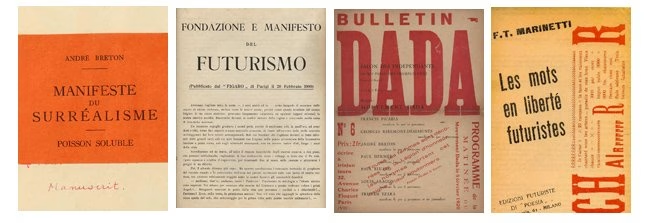
Literary scholars have been far too interested in the history of literature and far too little interested in the literature of history. Conforming to a disciplinary tradition that still prevails, literature tends to be seen as a closed room, a world of its own alongside the world. There are threads running between one work and another but not between a work and external reality. Literature changes according to its own laws and independently of events in society or the era that it proceeds from. Literary scholars chart stylistic concepts and changes in narrative techniques, experimenting with meanings beyond the individual who created the work and removed from historical circumstances.
For decades, close reading was the norm for many of the interpretative strategies in literary studies following its powerful debut shortly after the second world war, when it quickly spread. The literary scholar’s eye was never for a moment supposed to leave the actual literary text. Everything worth examining was encapsulated in the work. For literary modernists, this interpretive praxis was extremely favourable. They sidestepped troublesome questions about their ideological orientation, utopian dimension and political practice. So close reading was constructed and propagated by literary scholars close to literary modernists.
The phenomenon was known as New Criticism. Its children and grandchildren are legion. (In recent years, close readers have been challenged by literary scholars who seek out history – but unfortunately then mainly in order to moralise about it.)
Literary scholars interested in the literature of history rather than the history of literature approach literary modernists with questions other than those concerning literary technique and style. The genesis of literary modernism is related to the emergence of modernity, considered to be a reaction to the explosive development in the mid-19th century of a society characterised by technology and the mass market, a technology and mass market that essentially changed our living space and the conditions of life. The apex of literary modernism is placed around the time of the first world war, when large numbers of authors considered the era’s reaction to modernity to be sufficient or else simply viewed it as something to be taken for granted without further contemplation. The decline of literary modernism is connected with the change in conditions shaping people’s worldview entailed by the gigantic tug of war between liberalism, capitalism and democracy on the one hand and totalitarian ideologies and regimes on the other, a contest that culminated in the violence of the second world war but which continued to be relevant through the Cold War.
There is one issue that cannot be avoided if literary scholars who study literary modernism are interested in the literature of history, and that is the question of the literary modernists’ attitude to totalitarian ideologies and regimes. The peak phase of literary modernism can be called high modernism, and high modernism clearly also has a chronology and can be described as a process. Literary modernists wanted to save the individual and originality in an existence that came to be increasingly characterised by “the mass” and the uniform. This was indeed the basis of their reaction to modernity.
This question of attitudes to totalitarian ideologies arises as a consequence of the growing radicalness among literary modernists in general in their view of the protection and assertion of individuality, as they came to see black, red and brown Fascists as possible allies. They could fantasise about or take part in reshaping society and its ways of life or the establishment of an enduring elite within the scope of totalitarianism, a reshaping and establishment that was willingly violent in nature. The dream and affirmation of violence spread, violence that was to be directed at the multitudes, people who were all the same, the all too numerous, the commonplace, the insignificant, the mediocre. That dream and affirmation died in most literary modernists, but not all, when the everyday brutality of totalitarian societies became concrete and apparent. As a result, most of the air also leaked out of literary modernism. The adjoining figure illustrates the ideological paths of literary modernism. (I have also included Salvador Dalí, granted, mainly a visual artist.
The reason for this is that I want to draw attention to the widespread incompetence of contemporary Swedish art criticism. An exhibition on Norwegian figurative painting at Edsvik Art Gallery in the summer of 2009 was subject to complaints about Nazi taint, the only reason being that art bigwigs in the Third Reich preferred unironic and somewhat archaising figurative painting. A Dalí exhibition at Sweden’s Moderna Museet in the autumn of 2009 generated page after page of PR prose. Almost nowhere was the least consideration given to ideological dimensions, despite the fact that, unlike with the Norwegian painting in question, there is actually reason to do so. Among the objects in the exhibition, for instance, was a bust portraying Dali made by Arno Breker; an entire page was also devoted to it in the exhibition catalogue. Nowhere is it mentioned that Arno Breker was the most prominent sculptor of the Third Reich and Hitler’s personal favourite, known mainly for his many depictions of der Führer.)
The arc of high modernism, its path from illusion to disillusion, can be drawn with the help of five quotes:
1. F. T. Marinetti provides a fundamental course for the movement in his manifesto of Futurism in 1909: “Beauty exists only in struggle. There is no masterpiece that has not an aggressive character. Poetry must be a violent assault on the forces of the unknown, to force them to bow before man.”
2. Richard Huelsenbeck notes the reason for this auspicious opportunity in his first Dada speech in Germany in 1918: “We were against the pacifists because the war gave us the possibility of existing in our complete glory… We were for war and Dadaism is still for war today. Things have to strike each other; it still isn’t savage enough.”
3. D. H. Lawrence provides poetic form to his view of society and humanity in his poem “Democracy” from the 1920s:
I am a democrat in so far as I love the free sun in men
and an aristocrat in so far as I detest narrow-gutted, possessive persons.
I love the sun in any man
when I see it between his brows
clear, and fearless, even if tiny.
But when I see these grey successful men
so hideous and corpse-like, utterly sunless,
like gross successful slaves mechanically waddling,
then I am more than radical, I want to work a guillotine.
And when I see working men
pale and mean and insect-like, scuttling along
and living like lice, on poor money
and never looking up,
Then I wish, like Tiberius, the multitude had only one head
so that I could lop it off.
I feel that when people have gone utterly sunless
they shouldn’t exist.
4. André Breton gives practical advice about desirable confrontations in Surrealism’s Second Manifesto from 1930: “The simplest Surrealist act consists of dashing down into the street, pistol in hand, and firing blindly, as fast as you can pull the trigger, into the crowd. Anyone who, at least once in his life, has not dreamed of thus putting an end to the petty system of debasement and cretinisation in effect has a well-defined place in that crowd, with his belly at barrel level.” 5. Gottfried Benn declares the whole enterprise dead in a letter to Ina Seidel, dating from the Third Reich, 30 September 1934: “Spirit and art come not from victorious but from destroyed natures. This sentence is still valid in my eyes, just like the one that there is nothing realising this. There are only form and ideas. That is an understanding you cannot find in Nietzsche, or else he concealed it. His blond beast and his chapter on racial purity are largely dreams of joining spirit and power. That’s all over now. There are two different Reichs. As long as one is mistaken, it may be possible. But when one no longer can – then it’s over.”
The figure and five quotations can serve as an introductory course and an opening to a less naive understanding of the phenomenon of literary modernism.

Redan prenumerant?
Logga inUpptäck Axess Digital i 3 månader utan kostnad
Allt innehåll. Alltid nära till hands.
- Full tillgång till allt innehåll på axess.se.
- Tillgång till vårt magasinarkiv
- Nyhetsbrev direkt till din inbox